As Sancho II in the first dynasty, Afonso VI also revealed himself to be a rex inutilis, to use the happy phrase by the historian José Mattoso.
Afonso VI (Lisbon, August 21st, 1643 - Sintra, September 12th, 1683) was the twenty-second king of Portugal and the Algarves and the second of the House of Bragança, known as «o Vitorioso» (the Victorious) – all in all, History's pure irony…
At the age of three, Afonso suffered an illness that left him paralyzed on the left side of his body, as well as leaving him mentally unstable. His father created him 11th Duke of Bragança.
After the 1653 sudden death of his eldest brother Teodósio, Prince of Brazil and heir to the throne, Afonso became the heir-apparent.
He succeeded his father, João IV, in 1656 at the age of thirteen. His mother, D. Luísa de Gusmão (Medina-Sidonia), was named regent in his father's will.
His mental instability and paralysis, plus his disinterest in government, left his mother as regent for six years, until 1662. D. Luísa oversaw military victories over the Spanish armies at Ameixial (June 8th, 1663) and Montes Claros (June 17th, 1665), culminating in the final Spanish recognition of Portugal's independence on February 13th, 1668 in the Treaty of Lisbon, almost 28 years after Portugal had actually regained its independence as a sovereign State in 1640. Colonial affairs saw the cession of Bombay and Tangier to England (June 23rd, 1661) as dowry for Afonso's sister, Catherine of Bragança, who made an unfortunate marriage to Charles II of England.
In 1662, Count of Castelo Melhor saw an opportunity to gain power at court by befriending the king. He managed to convince him that his mother was out to steal the throne and exile him from Portugal. As a result, Afonso took control of the throne, and his mother entered a convent.
He was married to Marie Françoise, Mademoiselle de Nemours et d'Aumale, daughter of the Duke of Nemours, in 1666, but this marriage would not last long. Marie Françoise – or D. Maria Francisca Isabel de Sabóia in Portuguese – filled for an annulment in 1667 based on the impotence of the king. The Church granted her the annulment, and she married Afonso's brother, Pedro, Duke of Beja, future Pedro II.
That same year, Pedro managed to gain enough support to force his brother to relinquish control of the government, and so he became Prince Regent. Afonso was exiled to the island of Terceira in the Azores, returning to Portugal in 1674. He died in the Sintra Royal Palace in 1683.
Legend or not, part of the floor in his quarters shows evidence of being worn out by someone who had walked to and fro indefinitely…
Gonzalo Torrente Ballester, the eminent Spanish writer, published in 1989 «Crónica del Rey Pasmado» (Chronicle of The Flabbergasted King).
Afonso's trial is the base for José Mário Grilo's 1990 film «O Processo do Rei» (The King's Trial).
RIC & Wikipedia
quarta-feira, 3 de outubro de 2007
D. Afonso VI, the Flabbergasted King
Separadores:
História

domingo, 8 de julho de 2007
Kingdom of the Netherlands – «Het Wilhelmus»

William the Silent / Willem de Zwijger
Leader and icon of the Dutch revolt
"Het Wilhelmus" (The William) is the national anthem of the Kingdom of the Netherlands – Dutch: Koninkrijk der Nederlanden – and is the oldest national anthem in the world, though the lyrics of the Japanese, "Kimigayo", date as far back as the 9.th century.
It is also one of the very few anthems that do not focus on the History or military accomplishments of the people it represents; on the contrary, it tells of William of Oranje, his life and why he is fighting for the Dutch. As a result, the words of the anthem are as if they were said by William himself. The song is remarkably peaceful and was written around 1574.
On May 10.th 1932 it was decreed that on all official occasions requiring the performance of the national anthem "Het Wilhelmus" was to be played, hereby replacing Hendrik Tollens' "Wien Neerlands bloed door d'aderen vloeit" (Whom Dutch blood runs in the veins, Portuguese: A quem corre sangue neerlandês nas veias), which was the official Dutch anthem from 1815 till 1932.

"Het Wilhelmus" had been sung on many official occasions before and at many important events since 1568, such as the siege of Haarlem in 1573, and the ceremonial entry of the Prince of Oranje in Brussels on September 18.th 1578.
The tune of "Het Wilhelmus" is based on the French soldiers' song "Autre chanson de la ville de Chartres assiégée par le prince de Condé" (Another song about the city of Chartres under siege by the Prince de Condé, Portuguese: Outra canção da cidade de Chartres cercada pelo Príncipe de Condé), which was popular around 1569. During the siege the song had become quite popular among the Catholics of Chartres; the Protestants started to sing it too and made it spread to the Low Countries. Therefore the melody of "Het Wilhelmus" is older than the lyrics. The melody was further developed by the famous Dutch composer Adriaen Valerius (ca. 1575-1625), who made the melody's pace much slower, most likely to allow it to be sung in churches. The current official version is the arrangement by Walther Boer, dating from 1932.
The origins of the lyrics are less clear. Until today no one knows who exactly wrote the Dutch anthem. Soon after it was finished it was said that Philips of Marnix, a famous writer and statesman, former mayor of the city of Antwerp, or Dirk Coornhert, a politician and theologian, had written the anthem. However, this is disputed as both Marnix and Coornhert never mentioned they wrote the lyrics, which is strange given the fact that the song was immensely popular in their times.
Wilhelmus van Nassouwe
ben ik, van Duitsen bloed, (*)
den vaderland getrouwe
blijf ik tot in den dood.
Een Prinse van Oranje
ben ik, vrij, onverveerd,
de Koning van Hispanje
heb ik altijd geëerd.
William of Nassau
Am I, of Dutch blood. (*)
Loyal to the fatherland,
I will remain until I die.
A Prince of Oranje,
I am, free and fearless.
The King of Spain
I have always honoured.
Guilherme de Nassau
Sou eu, de sangue neerlandês.
Leal à pátria
Serei até morrer.
Um Príncipe de Oranje
Eu sou, livre e sem medo.
O Rei de Espanha,
Eu sempre honrei.
(*) There is an ongoing confusion and dispute as to what the author meant with "Duitsen bloed", as the contemporary Dutch word "Duits" means German, not Dutch.
In singing "Duits" is often replaced by "Diets", "Deutsch" or "Deitsch", all meaning Dutch rather than German.
This is done mostly, or even exclusively, due to an anti-German sentiment, which has been present in the Netherlands – the Low Countries – since the 16.th century. Today's resentment of Germans, however, comes mainly from the Dutch appalling experiences during World War II.
Although the exact meaning is still – and will probably remain – unclear, the official version of the Dutch national anthem uses "Duits".
Wikipedia (abridged and rewritten)
Dit postje werd gedacht ook als een klein cadeautje voor mijn beste nederlandse vrienden in Nederland en waar ze zich ook op de wereld mogen bevinden.
Het allerbeste voor jullie allemaal!
Hartelijke groetjes!
RIC
Separadores:
História
terça-feira, 3 de julho de 2007
On the origins of Sebastianism

D. Sebastião, o Desejado, King of Portugal
Born on January 20.th 1554, Sebastian died on August 4.th 1578. He was grandson and successor of John III, and was under the regency first of his grandmother Catarina and then of his uncle Henry – a cardinal and later king – until declared of age in 1568.
Weak and sickly, Sebastian was imbued by his Jesuit upbringing with fanatic religious fervor, which he combined with a tremendous admiration for the military. Thus he viewed himself as a Christian knight and became determined to win glory by fighting the Muslim infidels in Africa.
An appeal for help from a pretender to the Moroccan throne gave Sebastian his opportunity. Having secured in 1576 a promise of aid from Philip II of Spain, who was his uncle, he spent vast sums of money in preparation for an expedition against Morocco.
In 1578, Sebastian set out with a large force of foreign mercenaries (but no Spanish) and landed in Morocco. His headstrong desire to command and his lack of experience led to defeat in the Battle of the Three Kings at Ksar el Kebir/Alcácer-Quibir. His army was wiped out, and he himself was killed. However, it was not known at the time that he was dead, and rumor had it that he had been captured. The legend that he would return persisted, and Sebastianism (a messianic religious belief) lasted well into the 19.th century.
His uncle Henry succeeded him and was the last of the Aviz kings. The crown then went to Philip II, and Spanish control of Portugal began and lasted until 1640.
According to the legend that turned into a myth as time went by, King Sebastian would return on a misty morning to save Portugal in its darkest hour. His historical nickname is therefore "o Desejado" (the one wished for).
The Columbia Encyclopedia, Sixth Edition.
© 2004, Columbia University Press.
All rights reserved.
This is the beginning of one of the most "productive", recurring themes in Portuguese culture, namely in Portuguese literature.
Up to the present day, no major Portuguese writer, poet, playwright could ever help referring to this topic in his/her work.
In "La Raya Quebrada" (The Broken Border), a Spanish documentary on the relations between Portugal and Spain through History, it is said of King Sebastian that "he was deprived of the desire for women". A pearl shaped euphemism…
RIC
Separadores:
História
segunda-feira, 11 de junho de 2007
Os Meus 100 Tópicos de Cultura Portuguesa
| Açores – G Algarve – G Almada Negreiros – VA, L Almeida Garrett – L Álvaro Cunhal – P Amália Rodrigues – M Ana Salazar – F António Damásio – Sc António Salazar – P António Victorino d'Almeida – M Aqueduto das Águas Livres – Mn Aristides de Sousa Mendes – P, H Astrolábio – Sc Azulejo – VA Bacalhau com todos – Gtr Bocage – L Bordados – Hc Caldo verde – Gtr Camilo Castelo Branco – L Carlos Lopes – Sp Cármen Miranda – M Carne de porco à alentejana – Gtr Cascais – G Castelo de Guimarães – Mn Coimbra – G Convento de Cristo – Mn Convento de Mafra – Mn Cozido à portuguesa – Gtr Cristiano Ronaldo – Sp D. Afonso Henriques – H D. Dinis – H, L D. Pedro I – H Descobrimentos – H Dulce Pontes – M Eça de Queirós – L Egas Moniz – Sc Estoril – G Eusébio – Sp Évora – G Fátima Lopes – F Feijoada à transmontana – Gtr Fernando Lopes-Graça – M Fernando Pessoa – L Fernão Lopes – L, H Fernão Mendes Pinto – L, H Filigrana – Hc Francis Obikwelu – Sp Gil Vicente – L Inês de Castro – H Infante D. Henrique – H | Jorge de Sena – L José (Zeca) Afonso – M José Mourinho – Sp José Saramago – L Josefa d'Óbidos – VA Luís Figo – Sp Luís Vaz de Camões – L Madeira – G Madredeus – M Manoel de Oliveira – C Maria João Pires – M Mário Soares – P Mariza – M Marquês de Pombal – P Mízia – M Mosteiro da Batalha – Mn Mosteiro de Alcobaça – Mn Mosteiro dos Jerónimos – Mn Natália Correia – L, P Nazaré – G Nossa Senhora de Fátima – R Nuno Álvares Pereira – H, R Óbidos – G Os Lusíadas – L Paula Rêgo – VA Pedro Álvares Cabral – H Pedro Nunes – Sc Porto – G Queijo da Serra – Gtr Rainha Santa Isabel – H, R Revolução dos Cravos – P, H Rosa Mota – Sp Santo António – R Sardinhas assadas – Gtr Saudade – H, L, M Sintra – G, H, L Sophia de Mello Breyner A. – L Tapetes de Arraiolos – Hc Templo de Diana – Mn Terramoto de 1755 – H Torre de Belém – Mn Torre dos Clérigos – Mn Tripas à moda do Porto – Gtr Vale de Foz Côa – G, H Vale do Douro – G, Gtr Vasco da Gama – H Vieira da Silva – VA Vinho do Porto – Gtr Vinho verde – Gtr Viriato – H |
– CHAVE / KEY –
C – Cinema
F – Fashion/Moda
G – Geography
Gtr – Gastronomy
H – History
Hc – Handicraft/Artesanato
L – Literature
M – Music
Mn – Monuments
P – Politics
R – Religion
Sc – Science
Sp – Sports
VA – Visual Arts
Advertência: Quaisquer associações a produtos de entretenimento televisivo serão ofensivas ao carácter «sério» desta iniciativa. Mesmo que possamos rir a bom rir de alguns nomes apresentados…
Divirtam-se!
RIC
Separadores:
História
quarta-feira, 23 de maio de 2007
I. Lissabon: geschichtliches Porträt einer Weltstadt
Bereits die Phönizier und die Karthager sollen den Platz Alis Ubo («Liebliche Bucht») als einzigen großen Naturhafen an der iberischen Atlantikküste genutzt haben.
Archäologisch wurde dies bisher nicht bewiesen, hingegen aber griechische Siedlungsspuren sind gefunden worden.
Nach Plinius dem Älteren war Lissabon eine Gründung von Odysseus.
Ab 205 v. Chr. hieß die Stadt unter römischer Herrschaft Olisipo.
48 v. Chr. erhält sie unter Julius Caesar die römischen Stadtrechte und wird als Felicitas Julia Hauptort der Provinz Lusitania.
719 wird die Stadt von den Mauren erobert. Lissabon heißt al-Usbuna und erlebt seine erste Blütezeit.
• 1147: Es gelingt die Reconquista («Rückeroberung») der Christen unter König Afonso Henriques, dem ersten König Portugals.
• 12. Jahrhundert: Gegen Ende des 12. Jahrhunderts wird in Lissabon der heilige Antonius von Padua geboren, der zuweilen auch Antonius von Lissabon genannt und zelebriert wird.
1256 verlegt König Alfons III seine Residenz von Coimbra nach Lissabon.
• 1499: Am 9. September wird Vasco da Gama nach seiner ersten Indienreise ein triumphaler Empfang bereitet. Der in den folgenden beiden Jahrhunderten wachsende Handel mit den portugiesischen Gebieten in Afrika, Asien und Südamerika, aber auch deren Ausbeutung, führen zum Wohlstand der Stadt.
• 16. Jahrhundert: Zu Anfang des Jahrhunderts ist Lissabon mit 350.000 Einwohnern die größte Stadt der damals bekannten Welt.
1569 fordert eine Pestepidemie in Lissabon und Umgebung 60.000 Menschenleben.
• 1755: Am Morgen vom 1. November wird Lissabon durch ein furchtbares Erdbeben zu zwei Dritteln zerstört.
Nach heutigen Schätzungen hatte es die Stärke 8,7 bis 9,0.
Zeitgenössische Quellen geben allein für Lissabon bis zu 60.000 Todesopfer an.
Die Erschütterungen sind in ganz Europa und Nordafrika zu spüren.
Planmäßig wiederaufgebaut wird die Stadt von dem Markgrafen von Pombal, Minister des Königs Joseph I.
Besonders typisch für diesen Wiederaufbau ist die Baixa, die Unterstadt, mit ihren rechtwinklig angelegten Straßen im Bereich um die Rua Augusta.
Neben den physischen Schäden, die das Erdbeben anrichtet, erschüttert es auch die aufklärerischen und theistischen Denkrichtungen vieler Philosophen, die den Grund dieser Naturkatastrophe nicht sehen und ihren Optimismus aufgeben.
Voltaire schrieb als Reaktion auf das Beben sein "Poème sur le désastre de Lisbonne" (1756).
• 1910: Am 5. Oktober wird auf dem Balkon des Rathauses die Erste Portugiesische Republik ausgerufen. König Manuel II flieht ins Exil nach England.
• 1926: Ein Militärputsch beendet die Republik.
• 1928: António Salazar wird Finanzminister und später Ministerpräsident.
Während der Diktatur des Estado Novo («Neuen Staates») von 1926 bis 1974 wächst die Stadt weiter. Sie wird zu Lasten des restlichen Landes ausgebaut.
• 1959: Im Dezember wird die erste Metro-Linie in Lissabon eröffnet.
• 1966: Eine Hängebrücke über den Tejo nach Almada wird fertiggestellt, die der Golden-Gate-Brücke in San Francisco gleicht.
Vor der Nelkenrevolution (Revolução dos Cravos) noch nach António Salazar benannt, heißt sie nun Ponte 25 de Abril (Brücke des 25. April).
Oberhalb Almada steht mit Cristo-Rei zudem eine große Christus-Statue mit ausgebreiteten Armen, die der in Rio de Janeiro ähnlich sieht.
• 1968: Salazar erkrankt und stirbt 1970; Marcello Caetano wird sein Nachfolger.
• 1974: Am Frühmorgen vom 25. April ist Lissabon das Zentrum der Nelkenrevolution.
• 1988: Teile des Altstadtviertels Chiado werden durch einen Brand zerstört.
• 1994: Lissabon ist Kulturhauptstadt Europas.
• 1998: Fertigstellung der insgesamt über 17 km langen Autobahn-Brücke Ponte Vasco da Gama über den Tejo anlässlich der Weltausstellung EXPO '98.
• 2004: Haupt-Austragungsort und Schauplatz des Finales der Fußball Europameisterschaft.
• 2007: Am 7. Juli werden die 7 Neuen Weltwunder im Benfica-Stadion erklärt und bekanntgemacht werden.
«Quem não viu Lisboa, não viu coisa boa.» (Sprichwort)
Wer Lissabon nicht gesehen hat, hat nichts Schönes gesehen.
RIC
Separadores:
História
quarta-feira, 2 de maio de 2007
Did the Portuguese really «discover» Australia?...
Cristóvão de Mendonça was a Portuguese sailor and statesman, who was active in South East Asia in the 16.th century. He is known from a small number of Portuguese sources, notably João de Barros. Barros was one of the first great Portuguese historians − a «chronicler» −, most famous for his work «Décadas da Ásia» («Decades of Asia»), a history of the Portuguese empire in India and Asia, published between 1552 and 1615. Barros mentions that Cristóvão de Mendonça was the son of a Pedro de Mendonça, of Mourão, but his date of birth is not given. Mendonça later governed Hormuz as Captain-Major from 1527. He died there in 1532.
Mendonça is named by Barros as the captain of a ship that left Lisbon in 1519. He appears again in Barros’s account with instructions to search for Marco Polo’s legendary Isles of Gold. However, Mendonça and other Portuguese sailors are then described as assisting with the construction of a fort at Pedir, Sumatra, Indonesia. Barros promises to return to the topic of the voyage to the Isles of Gold, but does not.
In the late 20.th century Mendonça’s name became well known in Australian History discussions when it was connected to the Theory of Portuguese discovery of Australia by Kenneth McIntyre. While there are few Portuguese documents or maps beyond Barros that mention Mendonça, and none to directly connect Mendonça with Australia, McIntyre hypothesized that in 1521-24 Mendonça captained a fleet of three caravels which charted the east coast of Australia. McIntyre suggested that the voyage was kept secret because it would likely violate the ambiguous Treaty of Tordesillas, under which Portugal agreed that Spain would have exclusive rights to exploration in most of the Americas and the regions between the Americas and Asia. In addition he argued that many Portuguese records were lost in the disastrous 1755 Lisbon earthquake.
McIntyre’s identification of Mendonça as the likely commander of a Portuguese fleet that charted Australia’s east coast c. 1521-24 has also been accepted by other writers of the Theory of Portuguese discovery of Australia, including Lawrence Fitzgerald (1984) and Peter Trickett (2007). McIntyre suggested that one of Mendonça’s caravels sailed along the southeast coast of Australia and was wrecked somewhere near Warrnambool, Victoria, becoming the Mahogany Ship of Australian folklore − a myth? Although this wreck has not been seen since the 1880s, it is now often described in the Australian media as a Portuguese caravel or one of Mendonça’s fleet, largely on the basis of McIntyre’s theory.
In his 2007 book «Beyond Capricorn», science journalist Peter Trickett revealed other information relating to Mendonça’s life, including a fragment of stone engraved with Mendonça’s name found in South Africa and clearly dated to 1524, and a drawing that may show the 1519 fleet on its way to Goa. Trickett also connected Mendonça with the discovery of New Zealand’s north island.
Commenting on McIntyre’s theory in 1984, Captain A. Ariel suggested it was extremely unlikely any 16.th century mariner would have taken a voyage southwards down Australia’s east coast, through uncharted dangerous waters and against prevailing winds.
Associate Professor W.A.R. (Bill) Richardson of Flinders University, South Australia, believes the claim that Cristóvão de Mendonça sailed down the east coast of Australia is sheer speculation, based on voyages about which no real details have survived.
From Wikipedia (abridged)
... What about the so-called Delfim Map, which shows a lot of Portuguese toponyms on the Australian shores dating back as late 16.th, early 17.th centuries?...
I wonder...
RIC
Separadores:
História
sábado, 20 de janeiro de 2007
Portugal's 7 Wonders…
Esteemed members of the "Happy Few Club",
Dear readers,
I hereby invite you all to a journey that will take us on a visit to 7 of the 21 national monuments considered eligible to a place among the 7 best in the country. I have made my choices, and here are my final results.
I could have made other choices indeed, truth be told. However, I've tried to take into account different architectural styles and different periods of Portuguese History.
The main conclusion? Choices are never easy…
So let's get started right now!
 Jerónimos Monastery (detail), my closest neighbour. (Am I lucky or what?!)

Belém Tower (detail): unique in the whole world, it's an accomplished example of the 16.th century Manueline architectural style with military purposes
 Pena National Palace, 19.th century, a romantic architectural jewel in romantic Sintra, nearby Lisbon
 On an island in the mid-course of the Tagus we find Almourol castle, a medieval fortress. No words can describe the wondrous view from the top of its walls
 Nearby, Christ Convent at Tomar, and its most precious Manueline window
 After the victory at the battlefield of Aljubarrota over the Castilians, D. João I had this monastery built nearby – Saint Mary of Victory – in Portuguese late Gothic style
 … And our journey is finally going to take us to Coimbra, where we'll visit the Roman ruins of Conímbriga, a very well preserved archaeological site, the very birthplace of the university city of Coimbra.
I give you the list, just in case you may want to search for yourselves and to establish your own «Portugal's 7 Wonders» list. I believe you should! And if you're a Portuguese yourself I'm sure you should vote as well! Just go to www.7maravilhas.pt
Castelo de Guimarães
Castelo de Marvão
Castelo de Óbidos
Convento e Basílica de Mafra
Fortaleza de Sagres
Fortificações de Monsaraz
Igreja de São Francisco do Porto
Igreja e Torre dos Clérigos
Mosteiro de Alcobaça
Paço Ducal de Vila Viçosa
Universidade de Coimbra
Palácio de Mateus
Palácio Nacional de Queluz
Templo Romano de Évora
Enjoy your weekend!
RIC
Separadores:
História
sexta-feira, 8 de dezembro de 2006
D. João IV and his daughter Catarina, Queen of England
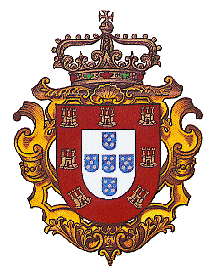 Shield of Arms of D. João IV
D. João IV (1603-1656) was king of "Portugal and the Algarves" from 1640 to his death. He was born at Vila Viçosa, in the province of Alentejo, and married D. Luísa de Gusmão (1613-1666), eldest daughter of the Duke of Medina-Sidonia, in 1633.
By the unanimous voice of the people he was raised to the throne, of which he was held to be the legitimate heir, during the revolution that restored the independence of the kingdom on December 1.st 1640.
In 1642 a treaty was signed between Portugal and England just before the outbreak of the English Civil War, and in 1661 an alliance between both kingdoms was renewed.
In 1646, D. João IV consecrated the nation to Our Lady of Immaculate Conception, who became henceforth the Patroness of Portugal. This is the reason why today is a religious holiday.
D. João IV was a patron of music and the arts, and a considerably sophisticated writer on music; in addition to this, he was a composer himself. During his reign he collected one of the largest music libraries in the world, which was destroyed in the earthquake of 1755. Among his writings are a Defence of Palestrina, and a Defence of Modern Music.

D. Catarina de Bragança, Rainha de Inglaterra
Catarina Henriqueta de Bragança (1638-1705), his daughter, became the queen consort of Charles II of England. They married on May 3.rd or 21.st 1662, in Portsmouth. Her dowry brought Tangier and Bombay to British control.
She was not a particularly popular choice of queen, being a Roman Catholic, which prevented her ever being crowned, since Roman Catholics were forbidden to take part in Anglican services.
Catarina never gave birth to a live heir, though she had several pregnancies, the last being in 1669. Her position was a difficult one, as Charles continued to have children by his many mistresses, but he insisted that she be treated with respect, and refused to divorce her.
Catarina introduced the custom of drinking tea in England.
Although some have claimed that Queens borough of New York City was named after Catarina de Bragança, her name is not mentioned in the first 200 years of historical documents that have been preserved in the county archives.
Following Charles' death, Catarina remained in England through the reign of James II and returned to Portugal in January 1693, during the joint reign of William III and Mary II. She died in Lisbon in 1705.
RIC (mainly adapted from "History of Portugal", Wikipedia, e.a.)
Separadores:
História
sexta-feira, 1 de dezembro de 2006
II. December 1.st in Portuguese History
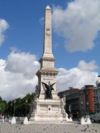 Restaurateurs' Monument and Square, Lisbon
The Restoration of Independence is a holiday commemorated on December 1.st to celebrate the recovery of national independence in 1640 from Spain under the rule of Felipe IV of Habsburg.
The Kingdom of Portugal had lost its independence in 1580, after the young Portuguese king Sebastião disappeared on the battle field of Alcazarquivir (in today's Morocco) in 1578, which put an abrupt end to the House of Aviz, Portugal's Royal Family since 1385.
Felipe II was crowned Felipe I of Portugal in 1580, and the Portuguese House of Habsburg – also called the Philippine Dynasty – began.
During 60 years, as Spain's enemies became Portugal's, a war with England led to a deterioration of the relations with Portugal's oldest ally (since the Treaty of Windsor in 1386) and the loss of Hormuz in the Persian Gulf; a war with the Dutch led to invasions of many places in Asia, and to the definite loss of commercial interests in Japan, Africa (S. Jorge da Mina, in today's Ghana), and South America.
As Felipe IV was trying to make Portugal a Spanish province, and Portuguese nobles were losing power and influence, this deteriorating situation culminated in a revolution by the Portuguese nobility and high bourgeoisie on December 1.st 1640.
It was planned by Antão Vaz de Almada, Miguel de Almeida and João Pinto Ribeiro – the so-called "Conjurados"; together with several associates, they defenestrated the Secretary of State Miguel de Vasconcelos, the traitor, and imprisoned the cousin of Felipe IV, the Duchess of Mantua, who had governed Portugal in his name. The moment was well chosen, as Spain was at the time fighting the Thirty Years' War and also facing popular riots in Catalonia.
D. João, 8.th Duke of Bragança, was acclaimed King of Portugal throughout the country as João IV. Portugal was independent again.
RIC (adapted and abridged from "History of Portugal", Wikipedia)
Separadores:
História
sábado, 18 de novembro de 2006
«Auschwitz: The Nazis & the 'Final Solution'»
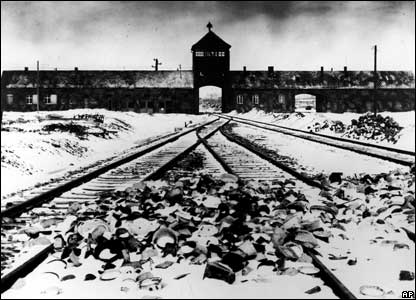
A BBC survey has suggested that almost half the adult population – 45% – claim to have never heard of Auschwitz.
Amongst women and people aged under 35 the figure is even higher – 60%. Among those who have heard of Auschwitz, 70% felt that they did not know a great deal about the subject.
Most of them – 76% – were unaware of its roots as a concentration camp for Polish political prisoners.
The majority – 74% – did not know that people other than Jews – Gypsies, homosexuals, Soviet war prisoners – were killed there and only a few recognised the name of the camp commandant – Rudolf Höß – or knew who finally liberated the camp at the end of the war – the Red Army.
Written and produced by Bafta Award-winning producer Laurence Rees and to mark the 60.th anniversary of the liberation of Auschwitz in January 2005, «Auschwitz: The Nazis and the 'Final Solution'» offers a unique perspective on the camp in which more than 1,100,000 people were ruthlessly murdered.
"The research reinforced the importance of making this series and trying to ensure the atrocities that unfolded at Auschwitz are never forgotten," says series producer Laurence Rees.
The series is the result of three years of in-depth research, drawing on the close involvement of world experts on the period, including Professors Sir Ian Kershaw and David Cesarani.
It is based on nearly 100 interviews with survivors and perpetrators, many of whom are speaking in detail for the first time.
Sensitively shot drama sequences, filmed on location using German and Polish actors, bring recently discovered documents to life on screen, while specially commissioned computer images give a historically accurate view of Auschwitz-Birkenau (Polish: Oświęcim-Brzezinka) at all its many stages of development.
"The name Auschwitz is quite rightly a byword for horror," says Laurence Rees. "Our series is not only about the shocking, almost unimaginable pain of those who died, or survived, Auschwitz. It's about how the Nazis came to do what they did. I feel passionately that being horrified is not enough. We need to make an attempt to understand how and why such horrors happened if we are ever to be able to stop them occurring again."
As I said, I had already watched this magnificent series when it was first released in January 2005. Watching it a second time – one episode a day – only made me realise better how such a tremendous catastrophe occurred by human hands. If I say I realise it better now it doesn't mean, however, I understand it. Because I don't and I believe I never will.
How can one cope with the fact that "normal people" turn into monsters, act as monsters, send about 200,000 children to death according to a spectral plan, and in the end, when they know they're reaching death themselves, claim the righteousness of their acts without a blink?
"After Auschwitz poetry is no longer possible," a poet said.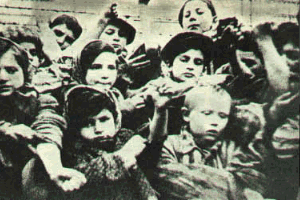
Separadores:
História
quarta-feira, 8 de novembro de 2006
Cabrilho's "discovery" of California
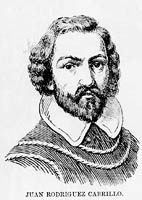
Strange as it may seem, Portuguese navigators were also involved in the exploration of the west coast of North America.
"In 1542-3, Portuguese-born João Rodrigues Cabrilho and his chief pilot Bartolomé (Bartolomeu) Ferrelo, who may have been Portuguese, were the first Europeans to explore the coast of the present state of California.
Sailing for the King of Spain Charles I – better known as Emperor Charles V – as Columbus and Fernão de Magalhães (Magellan) had sailed before, Cabrilho left in June of 1542 from Navidad on the west coast of Mexico and proceeded north. He reached San Diego Bay in September, becoming the first European to set foot in what is today the state of California. He continued north along the California coast but died in January 1543 from an infection resulting from a broken arm. Ferrelo continued north, possibly reaching the Oregon coast in March 1543.
Curiously enough, Magalhães had suffered a similar fate twenty years before: on the first successful attempt to sail around the entire Earth – the first circumnavigation ever – he was killed during the battle of Mactan on Cebu Island (one of the Maluku or Moluccas Islands) in the Philippines, in April 1521, taking over command of the expedition the Spaniard Juan Sebastián Elcano, who reached Spain the following year.
Little is known about Cabrilho's early years. Even his nationality is uncertain; most biographies describe him as Portuguese, but in his exhaustive 1986 biography "João Rodrigues Cabrilho", historian Harry Kelsey writes that Cabrilho appears to have been born in Spain, "probably in Seville, but perhaps in Cuellar." His date of birth and parentage are also unknown, but events in Cabrilho's life lead Kelsey to believe he was born of poor parents "around 1498 or 1500," and then worked for his keep in the home of a prominent Seville merchant."
However, if his name is João Rodrigues Cabrilho, as it seems to be the case, and not Juan Rodriguez Cabrillo, then the Portuguese hypothesis is a quite plausible one.
Separadores:
História
quarta-feira, 1 de novembro de 2006
Lisbon 1755: And the ground moved like the sea...
At about 9:30 a.m. on November 1.st 1755, south-western Europe experienced one of the largest earthquakes History has ever recorded. For 10 minutes the earth shook with a ferocity that geophysicists now estimate was around 9.0 on the Richter scale. Centred in the Atlantic 100 miles (160 km) west of Portugal, the earthquake was felt as far away as Finland, Italy, and England.

Lisbon was decimated, as were other cities in Portugal and North Africa. All the many medieval downtown churches were crowded to their fullest: it was All Saints' Day. Minutes after the quake, a tsunami hit. In Lisbon the height of the wave was 30 to 50 feet (9 to 15 m). Farther south it was closer to 100 feet (30 m). By afternoon the wave had travelled across the Atlantic and reached the Caribbean where the sea was observed to rise 3 feet (about 1 m). Best estimates place the number of dead in Lisbon at 30,000 to 60,000 out of a population of 250,000. Unknown thousands died elsewhere in Portugal and North Africa. Collapsed buildings, the tsunami, and a huge fire that burned on for a couple of weeks were responsible for those appalling numbers and altered Lisbon's landscape forever.
The Great Lisbon Earthquake, as it came to be known, got everybody's attention, partly because of its magnitude but also for several other reasons: it was the first great natural disaster to strike "modern" Europe. With improving transportation and communications, word of the disaster spread quickly and artists' drawings of the devastation were widely reproduced. In the developing climate of analytical and scientific thinking, it was the first great disaster widely attributed to natural causes and not – as had been previously done – to the actions of a vengeful deity unhappy with the sinful ways of humanity.
It was the first great natural disaster following which the recovery and rebuilding was assumed to be the job of the state itself and not – as had previously been the case – the responsibility of the church and the aristocracy. The earthquake imprinted deeply on European consciousness. Culturally, however, the effects are harder to document. Times were changing fast, and the quake was generally viewed as the natural – if disastrous – phenomenon that it was.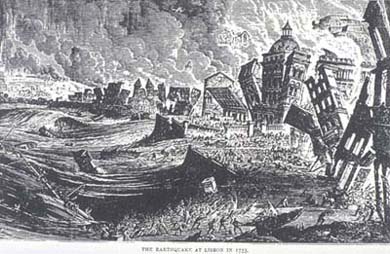
Even 130 years later, the catastrophe was still sufficiently vivid in memory to produce this picture in a British encyclopaedia of 1887
Famously, Voltaire used the event in "Candide" to write fini to Leibniz's view of this as the best of all possible worlds. Voltaire's initial reaction, upon first hearing of the quake, on November 25.th 1755, just three weeks after it happened: "This is indeed a cruel piece of natural philosophy! We shall find it difficult to discover how the laws of movement operate in such fearful disasters in the best of all possible worlds – families all over Europe reduced to beggary, fortunes of a hundred merchants swallowed up in the ruins of Lisbon. What will the preachers say – especially if the Palace of the Inquisition is left standing! [It wasn't!] I flatter myself that those reverend fathers, the Inquisitors, will have been crushed just like other people. That ought to teach men not to persecute men: for, while a few sanctimonious humbugs are burning fanatics, the earth opens and swallows up all alike."
Natural philosophers – as scientists were then known – studied the widespread and fairly well documented behaviour and effects of the quake and were for the most part baffled. In a larger cultural sense, the Great Lisbon Earthquake became an unforgettable, perhaps a traumatic, reminder of the fragility of the planet and of our place on it, the first such reminder of "modern" Europe.
On October 31.st 1755, lots of seeds were already germinating which would produce the world we know. The formation of the modern nation-state was well underway; forces of repression and liberation were in place that would lead to the American and French revolutions; the codification of the scientific method and the attendant development of technology were proceeding nicely. Kant was 30 years old, Goethe was six; Mozart hadn't even been born; nor had Coleridge, Keats, Shelley, Novalis, Hölderlin and that lot that would cause such ferment in the world of words, and would be known as the "Romantics". Was any of that changed or even accelerated by November 1.st?
The earth, though occasionally in its organic life causing us some problems – such as Lisbon –, has on the whole proved a beneficent parent, one which has given much and taken little. Line up all the natural disasters in recorded history and the total number of deaths would be minuscule compared to those resulting from our own, self-inflicted violence: 200,000,000 war dead in the 20th century alone! What has the planet done to us that might even approach that number?
Nothing yet. Not even close. Lisbon was – and is – a geo-reminder. On November 1.st 1755 the earth hiccupped. What will become of us and our vaunted culture when, finally, because of our mistreatment of its delicate balance, the planet vomits?
Separadores:
História
quinta-feira, 5 de outubro de 2006
Feriado Nacional: Implantação da República (1910)
… E, ingloriamente, uma Monarquia com quase oitocentos anos – uma das mais antigas da Europa! – esfuma‑se na e pela sua ignóbil indigência…
Eis os hodiernos símbolos nacionais, dos quais muito me orgulho, conquanto não seja nem patrioteiro de café nem republicano convicto.
Por vicissitudes da História que todos conhecemos, devo citar o Poeta quanto ao que melhor o terá definido enquanto Português. Professo a mesma verdade.
«A minha Pátria é a Língua Portuguesa.»
1. A bandeira verde e rubra.

2. «A Portuguesa».
Heróis do mar, nobre Povo,
Nação valente, imortal,
Levantai hoje de novo
O esplendor de Portugal!
Entre as brumas da memória,
Ó Pátria, sente-se a voz
Dos teus egrégios avós,
Que há-de guiar-te à vitória!
Às armas, às armas!
Sobre a terra, sobre o mar,
Às armas, às armas!
Pela Pátria lutar
Contra os canhões marchar, marchar!
Saudai o Sol que desponta
Sobre um ridente porvir;
Seja o eco de uma afronta
O sinal de ressurgir.
Raios dessa aurora forte
São como beijos de mãe,
Que nos guardam, nos sustêm,
Contra as injúrias da sorte.
Às armas, às armas!
Sobre a terra, sobre o mar,
Às armas, às armas!
Pela Pátria lutar.
A todos os bloguistas amigos, republicanos ou monárquicos, desejo um excelente feriado!
Separadores:
História