quinta-feira, 18 de Outubro de 2007

Divirtam-se! | Have fun!

Fiquem todos bem, minhas caras e meus caros!
Até breve! – C'est la vie
Prometo!


I wish you all, dear blogger friends, the very best!
I'll be away for a while; I'll be back as soon as possible.
Promise!

RIC

quarta-feira, 17 de Outubro de 2007

«Unforgettable»...


Unforgettable
That's what you are
Unforgettable
Though near or far

Like a song of love that clings to me
How the thought of you does things to me
Never before has someone been more

Unforgettable
In every way
And forever more
That's how you'll stay

That's why, darling, it's incredible
That someone so unforgettable
Thinks that I am unforgettable too

Irving Gordon

• Nat King Cole (1951-52)
• Dick Hyman Trio (1954)
• Dinah Washington (1959)
• Nat King Cole & Natalie Cole (1991)

RIC

terça-feira, 16 de Outubro de 2007

O princípio de mais um fim

«De início, quase tudo parecia idílico. Não estou a tentar pintar por cima de tons mais ou menos sombrios com límpidas cores luminosas e enganadoras. Aliás, também não o fiz então. Não foi a manifestação rápida de diferenças essenciais que começou a ensombrar aquele primeiro Verão. Elas não separam necessariamente e, em alguns aspectos, são até bem-vindas. Mas para quem se revelara tão intensamente carnal, tão visceralmente sensual, o fogo da paixão esmoreceu depressa, e foi essa mudança que me perturbou e confundiu.

Nunca fui propenso a constantes e desvairadas exteriorizações afectivas, nem pródigo em repartir ternuras e meiguices, beijos e carinhos. Mas sei também que não sou excessivamente regrado nem abstrusamente puritano. Percorremos juntos caminhos inexplorados, abrimo-nos ao erotismo, descobrimos o que de bom e mau a Rede Mundial oferece, embarcámos juntos em aventuras inconsequentes de telessexo que, como dizias, acumula as vantagens do sexo comum com a impossibilidade de ocorrerem situações incómodas, inibidoras ou automatizadas, enfim, puro sexo mental pelo simples prazer da novidade e da diferença. Se o prazer é por definição solitário, então que resulte pleno da junção premeditada de solidões…

O sexo foi-se tornando uma actividade desbravada. E desbragada. O conhecimento mútuo dos corpos, dos desejos secretos que calavam e dos caprichos intempestivos que se levantavam como vigorosos vendavais e só se aquietavam no instante do supremo gozo, foi-se apurando como se de uma iguaria cozinhada em lume brando se tratasse. Sem que alguma vez o tivesses notado ou sequer pressentido ou suspeitado, um estranho sentimento de irremediável perda foi-se insinuando em mim de uma forma cada vez menos suportável, como se a cada ejaculação ficasse mais perto da morte. Uma estranha bizarria no meu horizonte, consequência provável de uma idade que exige mais do que apenas a satisfação do desejo. No meu espírito foi-se instalando com firmeza a incómoda e absurda sensação de sémen desperdiçado, malbaratado, da inutilidade daquela actividade fora do contexto – inconfessável e impossível – de querer trazer ao mundo um novo ser, de garantir descendência, de procriar. Evitei e impedi como pude a proliferação destes pensamentos, frutos serôdios de um campo da vida há muito já em pousio.


Pode-se afinal muito pouco contra a força avassaladora da Natureza que, tarde ou cedo, se nos impõe como desígnio supremo da existência. Todo o racionalismo é pouco, débil e recente, ante a ancestralidade inconsciente da função vital. E combati como pude a crise, a meu ver, de meia-idade, aventurando-me lautamente por uma geografia da qual, até então, só conhecia as coordenadas básicas.

De início, havia todas as cores de todos os afectos e de todas as emoções a devolverem-me sentimentos de plenitude que pareciam há muito esgotados, sentia uma indómita vontade de te agradar e de secretamente realizar desejos teus apenas adivinhados. Palavras e actos concordavam e coincidiam. Mas, à medida que o esplendor estival se foi perdendo, a atmosfera idílica começou a adensar-se e as cores límpidas e transparentes ganharam matizes obscuros. Chegado o Outono, pouco faltou para que estabelecesses um calendário e um horário rígido, e qualquer iniciativa que quebrasse aquela rotina sub-reptícia, férrea e nunca negociada, era por ti mal recebida e tornava-se alvo de objecções inconsistentes, para mim, incompreensíveis. Ainda assim, o primeiro ano ainda manteve algum do esplendor daquele Verão e em nada se pode comparar ao que veio depois.

Havia paixão intensa, e creio hoje que um amor equilibrado poderia ter-lhe sucedido. O convívio contínuo não pode satisfazer-se apenas com insistentes trocas de carinhos e meiguices. Isso não passa de proximidade física. Os seres, mesmo os amantes, conversam, comunicam e comunicam-se nos interesses que perseguem e nos assuntos de que falam, tanto os triviais como os que os empolgam. As nossas conversas foram emudecendo e os nossos interesses foram-se revelando cada vez mais divergentes, opostos e incomunicáveis. Cada frase que proferia fazia-a preceder de um «olha», ainda que os nossos olhares não se desprendessem um só instante. Achava que um só «ouve» que eu dissesse poderia ter o indesejável efeito de tornar a conversa muito mais séria, muito mais grave. Quanto mais desentendido me fizesse, menores seriam as possíveis consequências nefastas da conversa. Ou da desconversa. Não se pode falar, a toda a hora e a todo o instante, do tempo que faz lá fora, do carro novo que um vizinho exibiu ou das compras de supermercado que há que fazer. E todas as conversas que tentavam ultrapassar o limiar da mera banalidade, da trivialidade comezinha e poderiam ir construindo outro tipo de proximidade, uma verdadeira intimidade, foram sendo adiadas sempre para mais tarde, sempre para depois. Para nunca. Quando havia que falar de nós, só mil cuidados impediam que o caminho seguido fosse invariavelmente o mesmo. E o silêncio foi ganhando terreno.»

RIC

segunda-feira, 15 de Outubro de 2007

Climate change & biodiversity…


United Nations Environment Programme
Key Polar Centre

«Climate change is impacting biodiversity at a global and unprecedented scale.
The Arctic region is hit particularly hard. It is already warming 2 to 2.5 times faster than the global average, due to a thinner atmosphere and several positive feedback responses.
Changes in the Arctic will have major repercussions for all other global regions through changes in the hydrological cycle, the weather cycle, the carbon cycle or atmospheric changes, but also by impacting its unique biodiversity.
Many Arctic species are migratory, connecting the entire globe by their annual migration routes of billions of migratory birds, marine mammals and fish.
The changes in the Arctic region will determine the future of its major wealth in ecosystem goods and services, mostly its natural resources, marine and freshwater fish and terrestrial reindeer. They all provide vital income for the peoples of the North and to a large extent to the global community as a whole.
Its unique location in still largely pristine wilderness and little direct human impacts allow the Arctic region for monitoring the impact of climate change and industrial development on biodiversity in a less complex ecosystem, providing us with an early warning system of what is likely to happen to our near future.
Arctic biodiversity and ecosystems are an ideal test case for measuring progress towards the Convention on Biological Diversity's 2010 target to significantly reduce the rate of biodiversity loss by 2010, a barometer for the state of biodiversity.
The Circumpolar Biodiversity Monitoring Program is part of the International Polar Year initiative, which creates a huge scientific focus on the Polar regions, generating the attention to the vulnerable status of both poles. More than 100 projects focus on the Arctic region.


Arctic biodiversity is more than just the Polar Bear. This charismatic Arctic predator has been the focus of the media, rightly reporting on the sombre destiny of the largest predator on Earth. It will suffer severely if the sea ice continues to disappear in many areas of the Arctic. But little has been mentioned on the fate of other Arctic species, namely the following four.

● The charismatic, solely Arctic Ivory Gull pagophila eburnea is living entirely in High Arctic marine seas, closely associated with the Polar Bear, which it follows, scavenging on leftovers on the ice edge. Its entire life cycle is intimately linked with sea ice and the rare gull is potentially severely threatened by the disappearance of the sea ice.

● The Reindeer and Caribou rangifer tarandus are the most dominant large mammal species in the Arctic, living in every Arctic country, mostly in the tundra. They provide the major source of income for many local people in the Arctic, depending highly on the thriving of their huge populations. Climate change may have severe impacts on the future of this valuable element of Arctic ecosystems.

● Polar regions are home to 70% of all global freshwater, most of it stored in the ice sheets of Antarctica and Greenland, but the Arctic region contains the largest amount of freshwater available for biodiversity. Huge peatlands and tundra wetlands lie in the Arctic region, and Arctic rivers altogether discharge more than 4,600 km3 into the Arctic Ocean every year. Many of them belong to the largest ten rivers on Earth, hardly impacted by dams or any other human impacts, allowing a huge diversity of freshwater fish to thrive in their streams. The Arctic Char salvelinus alpinus is the most northerly distributed freshwater fish and a characteristic representative for this unique biome.

● The large majority of all Arctic vertebrates are migratory. Arctic breeding birds are connected with virtually every corner of the globe – apart from the Antarctic ice sheet – through the annual migration of birds, whales, fish and even reindeer and caribou. The Red Knot calidris canutus is one of the most fascinating globetrotters. In winter the High Arctic breeder can be found in South and West Africa, South America, India, Australia and New Zealand. However, four out of six populations are presently in decline, some sharply, and for two the trend is unknown.


These, like many other population trends from the Arctic regions, are alarming signals of changes in the Arctic ecosystems, which should alert us all. We still do not know the trend for many populations of Arctic biodiversity and we still know far too little as well to fully understand the root causes of these trends.»

Do you still believe never-ending economical growth rates are more important?
I don't! Not anymore!

RIC

domingo, 14 de Outubro de 2007

Anexins de trazer por casa…

• A capacidade de contar uma história acintosamente inventada é o que mais nos aproxima da infância, sempre cada vez mais fugidia, numa memória cada vez mais escusa.

• Se o hábito não faz o monge, tão-pouco o milagre faz o santo.

• Se acaso conseguisse agora compenetrar-me de que estou nesta vida por algum desígnio especial que me acompanharia até ao meu derradeiro instante neste mundo, em que é que isso doravante modificaria a minha existência?


• O neoproletariado licenciado e doutorado é uma inegável aquisição do capitalismo selvagem.

• Agrada-me que pensem que não sou flor que se cheire ou que tenho mau feitio; é a defesa ideal de ataques que desnecessariamente me consumiriam.

• A insustentável ganância do crescimento económico ad infinitum conduz inevitavelmente ao colapso do processo e, com ele, do próprio sistema; não é necessário ser marxista para o prever.

sábado, 13 de Outubro de 2007

De pulchritudine…

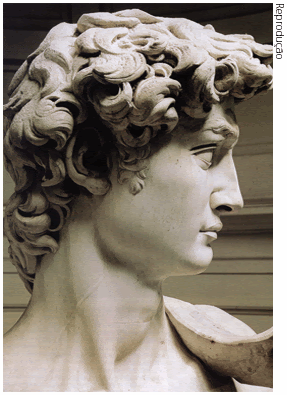
Estátua

Cansei-me de tentar o teu segredo:
No teu olhar sem cor, – frio escalpelo,
O meu olhar quebrei, a debatê-lo,
Como a onda na crista dum rochedo.

Segredo dessa alma e meu degredo
E minha obsessão! Para bebê-lo
Fui teu lábio oscular, num pesadelo,
Por noites de pavor, cheio de medo.

E o meu ósculo ardente, alucinado,
Esfriou sobre o mármore correcto
Desse entreaberto lábio gelado…

Desse lábio de mármore, discreto,
Severo como um túmulo fechado,
Sereno como um pélago quieto.

Clepsidra
Camilo Pessanha


Song of the Bronze Statue

Gone that emperor of Maoling,
Rider through the autumn wind,
Whose horse neighs at night
And has passed without trace by dawn.

The fragrance of autumn lingers still
On those cassia trees by painted galleries,
But on every palace hall the green moss grows.

As Wei's envoy sets out to drive a thousand li
The keen wind at the East Gate stings the statue's eyes…

From the ruined palace he brings nothing forth
But the moonshaped disk of Han,
True to his lord, he sheds leaden tears,
And withered orchids by the Xianyang Road
See the traveller on his way.

Ah, if Heaven had a feeling heart, it, too, must grow old!
He bears the disk off alone
By the light of the desolate moon,
The town far behind him, muted its lapping waves.

Li He
Chinese classical poet
9th century A.D.


RIC

sexta-feira, 12 de Outubro de 2007

Doris Lessing – LNPW (*) 2007


(*) Literature Nobel Prize Winner

She was described as «that epicist of the female experience, who with scepticism, fire and visionary power has subjected a divided civilisation to scrutiny».

Exposing the Extraordinary in the Ordinary

«Doris Lessing's career shows that a strict pattern of formal schooling is not the only way to success. Lessing was born in Persia (now Iran), to British parents, but her family moved to Southern Rhodesia (now Zimbabwe) in hope of a better future. However, that future never really materialized and Lessing's childhood was difficult. She ended formal schooling at fourteen, largely educating herself through voracious reading, and left home at fifteen. A lifelong critic of colonialism and racism, she eventually moved to London in 1949.

Given that Lessing has many points of origin, it is perhaps not surprising that she can create such an intense sense of place in her writing. She has written over fifty books, starting with The Grass is Singing, set in Africa, and her output includes novels, short stories, a graphic novel, plays, non-fiction, and two operas with Philip Glass.

Possible starting points for readers unfamiliar with her work might be the Martha Quest-series of novels and Time Bites, a collection of essays published in 2004. In the 1980s, she published two novels under the pseudonym Jane Somers, to prove just how difficult it is for an unknown name to get their work published: both novels were rejected by Lessing's usual publisher!

Lessing has said that writing enables her to take something that is raw and unexamined and give it general significance. Her writing is clearly in the tradition of Dickens, Tolstoy and Dostoyevsky, the writers she read as a teenager, with its strong ethical focus and engagement with society. Indeed, perhaps her most famous novel, The Golden Notebook, a dissection of a woman's psyche which is torn between emotional, social and creative demands, has been very influential on feminism.

Writing, Lessing says, also gives her freedom – a freedom revealed in her willingness to probe conventions, to give voice to the repressed, dismissed, and inarticulate, but also displayed in her willingness to experiment. She has mixed high literature with more popular forms, like science fiction, and has daringly employed strange combinations of time-schemes, perspective, allegory, and naturalism in an attempt to access what she sees as the deeper reality of mysticism, dreams and even madness.

Describing her perspective on her own life as constantly changing, Lessing always remains open to new ideas and possibilities.»

Georgia Brown, for Nobelprize.org

… I just adore an old woman's smiling face!
Congratulations, dear Doris!

RIC