 Should I loose my temper?
Should I get into a state?
Should I curse my fortune?
Should I say "No. Period."?
Should I say "Sorry, but Alice doesn't live here anymore"?
Should I say "I've already given for that charity work"?
Should I say "Are ya talkin' to me, an incorrigible smoker?!"?
I guess I could say lots of crap. I guess I could just say no.
But I just cannot say no to a friend who, though away from his computer and from the blogosphere on the other side of the world, has a kind thought for his friends and sends them postcards; or, while on vacation in southern England and dealing with family difficulties, takes his time to write some more postcards. That's Minge. (Have a look!)
And, last but not least, I wouldn't miss the opportunity to please myself and make a list of pop-ish songs I like. I won't go into the detail of naming the singer. You choose the interpreter, dear blogger friends, in case there are several.
I don't mind about that. Music is eternal, not voices. Here it is then:
● Starry, Starry Night
● Killing Me Softly With His Song
● I Will Survive
● And I Love You So
● You've Got A Friend
● I Love The Nightlife
● It's Raining Men
● Save The Best For Last
● September Morning
● As They Say
NB - This is no Top Ten. This is just a glimpse of mine at the Anglo‑Saxon music scenery; there are hundreds more, all lovable – in English, Portuguese, French, Italian, Spanish, you name it… It all began in the 60's, remember…?
Will you now stop tagging me, Minge? Pleeeaaase!
sexta-feira, 3 de novembro de 2006
Tagged again...
Separadores:
Mêmes e Testes

quinta-feira, 2 de novembro de 2006
II. «De la beauté avant toute chose…»
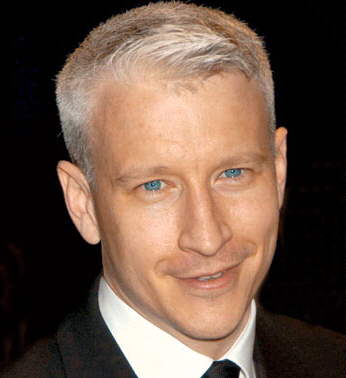
Anderson Cooper
Digam‑me tudo o que vos apetecer sobre este rosto…
Tell me all you feel like about this face…
Dites-moi sur ce visage tout ce dont vous avez envie…
Sagt mir alles, was euch über dieses Gesicht einfällt…
Díganme todo lo que les dé la gana de esa cara…
Separadores:
Estesias
I. Sobre literatura homófila (3)


Que ao título A Boy's Own Story de EDMUND WHITE não corresponde o português – A Vida Privada de Um Rapaz – é questão pacífica. Transpor para português um registo sui generis do inglês norte-americano é tarefa difícil, que é levada a muito bom termo por José Vieira de Lima, resultando num texto em português atraente, literariamente válido. Impõe-se uma objecção ao título original: as histórias contadas não provêm de um narrador adolescente hic et nunc, mas da memória de um narrador adulto. So much for A Boy's Own Story… O título português é, pois, mais verosímil porque mais consentâneo com a verdade ficcional.
Um narrador anónimo (autobiográfico) é localizável algures na idade adulta, a partir da qual procede a excursos retrospectivos em busca de um tempo perdido: a adolescência. O objectivo desta revisitação é óbvio: encontrar as explicações, as justificações de que necessita para seu próprio governo (e do seu narcisismo).
Basicamente, há uma obsessão: a necessidade, por vezes pungente, de reconhecimento social que, à norte-americana, se rescreve "ser popular". Com alguma filosofia à mistura, o narrador afirma que "ser popular equivalia a tornar‑me uma personagem, talvez mesmo uma pessoa, pois se ser é ser percebido, então ser percebido por muitos olhos e com inveja, interesse, respeito ou afeição [atente-se nos pólos da gradação], é existir mais densamente, mais articuladamente."
Depois, há a aprendizagem de ser-percebido: "aprendi que o amor ou pelo menos a amizade têm de ser conquistados com prendas e agrados, que há jeitos e artes (escutar, sorrir, lembrar, lisonjear)." Entretanto, há a vontade de cura para o supremo mal: "Se a minha homossexualidade se devia a um excesso de presença feminina na família (...), então a melhor maneira de corrigir esse desequilíbrio seria entrar para um mundo totalmente masculino. A fim de me tornar um heterossexual, decidi que iria para um colégio interno só para rapazes." Mas estas são as palavras de um narrador adulto descrente de teorias ou práticas terapêuticas. Vem, em socorro do adolescente, o shrink da praxe. E para que do caos surja a ordem, eis quase uma isotopia, muito bem organizada a partir da oposição heterossexualidade/homossexualidade masculinas: negócio/arte, coisas/pessoas, mulheres/homens, pai/mãe, desportos/livros, responsabilidades/sentimentos e dinheiro/ amor. Tudo muito bem arrumadinho.
Um anacronismo insustentável surge pela voz do narrador que, com quinze anos e como se iluminado, debita um Michel Foucault avant la lettre, numa desvairada sinopse da tese da História da Sexualidade. So much for the boarding school for boys only – Eton, de seu nome.
O romance, em que a adjectivação amiúde se descontrola, termina em queda. Proliferam as referências culturais – a propósito e a despropósito – e as efusões líricas, de gosto literário duvidoso e extensão desmedida. Um texto mais enxuto teria, seguramente, a ganhar em qualidade literária e valor testemunhal.
RIC
Esta recensão foi publicada pela primeira vez na revista "Cartaz" do semanário "Expresso".
Para conhecer a bibliografia original do autor, clique no seu nome.
Separadores:
Literaturas
quarta-feira, 1 de novembro de 2006
Lisbon 1755: And the ground moved like the sea...
At about 9:30 a.m. on November 1.st 1755, south-western Europe experienced one of the largest earthquakes History has ever recorded. For 10 minutes the earth shook with a ferocity that geophysicists now estimate was around 9.0 on the Richter scale. Centred in the Atlantic 100 miles (160 km) west of Portugal, the earthquake was felt as far away as Finland, Italy, and England.

Lisbon was decimated, as were other cities in Portugal and North Africa. All the many medieval downtown churches were crowded to their fullest: it was All Saints' Day. Minutes after the quake, a tsunami hit. In Lisbon the height of the wave was 30 to 50 feet (9 to 15 m). Farther south it was closer to 100 feet (30 m). By afternoon the wave had travelled across the Atlantic and reached the Caribbean where the sea was observed to rise 3 feet (about 1 m). Best estimates place the number of dead in Lisbon at 30,000 to 60,000 out of a population of 250,000. Unknown thousands died elsewhere in Portugal and North Africa. Collapsed buildings, the tsunami, and a huge fire that burned on for a couple of weeks were responsible for those appalling numbers and altered Lisbon's landscape forever.
The Great Lisbon Earthquake, as it came to be known, got everybody's attention, partly because of its magnitude but also for several other reasons: it was the first great natural disaster to strike "modern" Europe. With improving transportation and communications, word of the disaster spread quickly and artists' drawings of the devastation were widely reproduced. In the developing climate of analytical and scientific thinking, it was the first great disaster widely attributed to natural causes and not – as had been previously done – to the actions of a vengeful deity unhappy with the sinful ways of humanity.
It was the first great natural disaster following which the recovery and rebuilding was assumed to be the job of the state itself and not – as had previously been the case – the responsibility of the church and the aristocracy. The earthquake imprinted deeply on European consciousness. Culturally, however, the effects are harder to document. Times were changing fast, and the quake was generally viewed as the natural – if disastrous – phenomenon that it was.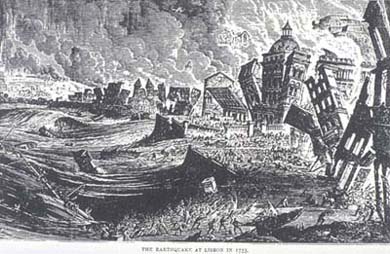
Even 130 years later, the catastrophe was still sufficiently vivid in memory to produce this picture in a British encyclopaedia of 1887
Famously, Voltaire used the event in "Candide" to write fini to Leibniz's view of this as the best of all possible worlds. Voltaire's initial reaction, upon first hearing of the quake, on November 25.th 1755, just three weeks after it happened: "This is indeed a cruel piece of natural philosophy! We shall find it difficult to discover how the laws of movement operate in such fearful disasters in the best of all possible worlds – families all over Europe reduced to beggary, fortunes of a hundred merchants swallowed up in the ruins of Lisbon. What will the preachers say – especially if the Palace of the Inquisition is left standing! [It wasn't!] I flatter myself that those reverend fathers, the Inquisitors, will have been crushed just like other people. That ought to teach men not to persecute men: for, while a few sanctimonious humbugs are burning fanatics, the earth opens and swallows up all alike."
Natural philosophers – as scientists were then known – studied the widespread and fairly well documented behaviour and effects of the quake and were for the most part baffled. In a larger cultural sense, the Great Lisbon Earthquake became an unforgettable, perhaps a traumatic, reminder of the fragility of the planet and of our place on it, the first such reminder of "modern" Europe.
On October 31.st 1755, lots of seeds were already germinating which would produce the world we know. The formation of the modern nation-state was well underway; forces of repression and liberation were in place that would lead to the American and French revolutions; the codification of the scientific method and the attendant development of technology were proceeding nicely. Kant was 30 years old, Goethe was six; Mozart hadn't even been born; nor had Coleridge, Keats, Shelley, Novalis, Hölderlin and that lot that would cause such ferment in the world of words, and would be known as the "Romantics". Was any of that changed or even accelerated by November 1.st?
The earth, though occasionally in its organic life causing us some problems – such as Lisbon –, has on the whole proved a beneficent parent, one which has given much and taken little. Line up all the natural disasters in recorded history and the total number of deaths would be minuscule compared to those resulting from our own, self-inflicted violence: 200,000,000 war dead in the 20th century alone! What has the planet done to us that might even approach that number?
Nothing yet. Not even close. Lisbon was – and is – a geo-reminder. On November 1.st 1755 the earth hiccupped. What will become of us and our vaunted culture when, finally, because of our mistreatment of its delicate balance, the planet vomits?
Separadores:
História
terça-feira, 31 de outubro de 2006
Let's fly away...

"Legends of witches flying on brooms go back as far as the beginning of the Christian Era. The earliest known confession of a witch flying on a broom was in 1453, when Guillaume Edelin of St. Germain-en-Laye, near Paris, stated that he had done so. In 1563, Martin Tulouff of Guernsey said to have seen his aged mother straddle a broomstick and whisk up the chimney and out of the house on it, saying "Go in the name of the Devil and Lucifer over rocks and thorns". In 1598 Claudine Boban and her mother, witches of the province of Franche-Comté, eastern France, also spoke of flying up the chimney on a stick. The belief of flying off through the chimney became firmly embedded in popular tradition, although only a few people ever mentioned doing so. It has been suggested that this idea was connected with the old custom of pushing a broom up the chimney to indicate the absence of the housewife. The Germanic goddess Holda or Holle is also connected with the chimney.
Other indications that lead to the popular belief that witches actually flew on broomsticks can be found in an old custom of dancing with a broom between the legs, leaping high in the air.
Some authors claim that the oldest known source of witches flying on broomsticks is a manuscript called "Le Champion des Dames" by Martin Lefranc, 1440. This might be one of the oldest images representing a hag on a broomstick, but it is certainly not the first. A wall painting from the 12.th century in Schleswig Cathedral (Germany) shows the Norse deity Frigg riding her staff.
From the Roman world there are reports that mention witches flying on broomsticks as well as having used ointments, as early as the first century. They were called Straigæ, and the Lamiæ from Greek culture had similar characteristics. Later in Roman history, the goddess Diana was the leader of the Wild Hunt: "It is also not to be omitted that some wicked women, perverted by the Devil, seduced by illusions and phantasm of demons, believe and profess themselves in the hours of the night to ride upon certain beasts with Diana, the goddess of pagans, and an innumerable multitude of women, and in the silence of the dead of the night to traverse great spaces of earth, and to obey her commands as of their mistress, and to be summoned to her service on certain nights".
Similar beliefs existed in many parts of Europe. So flying through the air, evidently, was a deeply rooted mythological theme, associated with the free roaming of the spirit, the separation of soul and body.
The broomstick is a female and male symbol, "the rod which penetrated the bush". Its symbolism and interpretation is therefore purely sexual."
The Witchy Crypt
Separadores:
Efemérides
segunda-feira, 30 de outubro de 2006
Sencillo homenaje a Latinoamérica y España
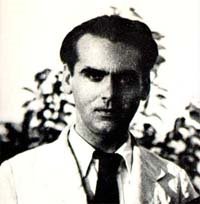
Hace tiempo, mucho tiempo que quería hacerlo aquí.
Pero mi español es un desastre, lo sé… Es sobre todo "portuñol", como el de casi todos nosotros portugueses que creemos que hablamos español sin (casi) nunca haberlo aprendido… ¡Y escribirlo es aun mucho más difícil!
Hasta que pensé que un lindo poema seria sin duda la buena solución para saludar a todos los blogueros de Latinoamérica y España que visitan a mi blog. Lo hacen en silencio, un silencio muy poco latino, hay que decirlo…
Os deseo a todos lo mejor y os dejo en la compañía de un individuo mayor de la cultura mundial, un gran señor de la poesía – Federico García Lorca.
Me gusta muchísimo eso poema… Me encanta hace muchos años… Seguro que no es uno de sus poemas más jubilosos, pero es sin duda uno de sus mejores.
Romance Sonámbulo
A Gloria Giner
y a Fernando de los Ríos
Verde que te quiero verde.
Verde viento. Verdes ramas.
El barco sobre la mar
y el caballo en la montaña.
Con la sombra en la cintura
ella sueña en su baranda,
verde carne, pelo verde,
con ojos de fría plata.
Verde que te quiero verde.
Bajo la luna gitana,
las cosas le están mirando
y ella no puede mirarlas.
Verde que te quiero verde.
Grandes estrellas de escarcha,
vienen con el pez de sombra
que abre el camino del alba.
La higuera frota su viento
con la lija de sus ramas,
y el monte, gato garduño,
eriza sus pitas agrias
¿Pero quién vendrá? ¿Y por dónde...?
Ella sigue en su baranda,
verde carne, pelo verde,
soñando en la mar amarga.
Compadre, quiero cambiar
mi caballo por su casa,
mi montura por su espejo,
mi cuchillo por su manta.
Compadre, vengo sangrando,
desde los montes de Cabra.
Si yo pudiera, mocito,
ese trato se cerraba.
Pero yo ya no soy yo,
ni mi casa es ya mi casa.
Compadre, quiero morir
decentemente en mi cama.
De acero, si puede ser,
con las sábanas de holanda
¿No ves la herida que tengo
desde el pecho a la garganta?
Trescientas rosas morenas
lleva tu pechera blanca.
Tu sangre rezuma y huele
alrededor de tu faja.
Pero yo ya no soy yo,
ni mi casa es ya mi casa.
Dejadme subir al menos
hasta las altas barandas,
dejadme subir, dejadme,
hasta las verdes barandas.
Barandales de la luna
por donde retumba el agua.
Ya suben los dos compadres
hacia las altas barandas.
Dejando un rastro de sangre.
Dejando un rastro de lágrimas.
Temblaban en los tejados
farolillos de hojalata.
Mil panderos de cristal,
herían la madrugada.
Verde que te quiero verde,
verde viento, verdes ramas.
Los dos compadres subieron.
El largo viento, dejaba
en la boca un raro gusto
de hiel, de menta y de albahaca
¡Compadre! ¿Dónde está, dime?
¿Dónde está mi niña amarga?
¡Cuántas veces te esperó!
¡Cuántas veces te esperara,
cara fresca, negro pelo,
en esta verde baranda!
Sobre el rostro del aljibe
se mecía la gitana.
Verde carne, pelo verde,
con ojos de fría plata.
Un carámbano de luna
la sostiene sobre el agua.
La noche su puso íntima
como una pequeña plaza.
Guardias civiles borrachos,
en la puerta golpeaban.
Verde que te quiero verde.
Verde viento. Verdes ramas.
El barco sobre la mar.
Y el caballo en la montaña.
Pueden dejar vuestros comentarios. Mi dificultad no será tanto leerlos y entenderles, sino contestarles… ¡Haré mi mejor posible!
¡Saludos amigos desde Lisboa!
Separadores:
Literaturas
domingo, 29 de outubro de 2006
«Maximen und Reflexionen»
 Johann Wolfgang von Goethe
"Begegnet uns jemand, der uns Dank schuldig ist, gleich fällt es uns ein. Wie oft können wir jemanden begegnen, dem wir Dank schuldig sind, ohne daran zu denken."
If someone meets us, who owes us thanks, it will immediately occur to us. How often can we meet someone, whom we owe thanks, without remembering?
"Große Leidenschaften sind Krankheiten ohne Hoffnung. Was sie heilen könnte, macht sie erst recht gefährlich."
Great passions are diseases without hope. What could heal them only makes them quite dangerous.
"Es gibt keinen größeren Trost für die Mittelmäßigkeit, als daß das Genie nicht unsterblich ist."
There is no greater comfort for the mediocrity than that the genius is not immortal.
"Wer fremde Sprachen nicht kennt, weiß nichts von seiner eigenen."
He who does not know foreign languages knows nothing about his own.
"Was man nicht versteht, besitzt man nicht."
What one does not understand, one does not possess.
"Ein jeder, weil er spricht, glaubt, auch über die Sprache sprechen zu können."
Everyone, because they speak, believe they are able to speak also about the language.
"Eine Chronik schreibt nur derjenige, dem die Gegenwart wichtig ist."
A chronicle writes only the one, to whom the present is important.
"Eigentlich weiß man nur, wenn man wenig weiß; mit dem Wissen wächst der Zweifel."
Actually one knows only if one knows little; with the knowledge the doubt grows.
"Unter allen Völkerschaften haben die Griechen den Traum des Lebens am schönsten geträumt."
Among all peoples, the Greeks dreamed the dream of the life most beautifully.
Sunday is a fine day for some reflection and meditation. Just sit back and relax...
Separadores:
Sagezas
sábado, 28 de outubro de 2006
Four sons / Quatro filhos
Time for a joke to cheer up!
Four friends, who hadn't seen each other in many years, are reunited at a party. After several drinks, one of the men had to use the rest room. Those who remained talked about their sons.
The first guy said: "My son is my pride and joy. He started working at a successful company at the bottom of the barrel. He studied Economics and Business Administration and soon began to climb the corporate ladder and now he's the president of the company. He became so rich that he gave his best friend a top of the line Mercedes for his birthday."
The second guy said: "Darn, that's terrific! My son is also my pride and joy. He started working for a big airline, and then went to flight school to become a pilot. Eventually he became a partner in the company, where he owns the majority of its assets. He's so rich that he gave his best friend a brand new jet for his birthday."
The third man said: "Well, that's terrific! My son studied in the best universities and became an engineer. Then he started his own construction company and is now a multimillionaire. He also gave away something very nice and expensive to his best friend for his birthday – a 30,000 square foot mansion…"
The three friends congratulated each other just as the fourth returned from the restroom and asked: "What are all the congratulations for?"
One of the three said: "We were talking about the pride we feel for the successes of our sons. What about yours?"
The fourth man replied: "Well, my son's gay and makes a living dancing as a stripper at a nightclub."
The three friends said: "What a shame…! What a disappointment…!"
The fourth man replied: "No, I'm not ashamed at all. Why should I be? He's my son and I love him very much. Besides he hasn't done too bad either. His birthday was two weeks ago, and he received a beautiful 30,000 square foot mansion, a brand new jet and a top of the line Mercedes from his three boyfriends."
(Slightly changed)
Posted by Robguy on October 5.th
Venha uma anedota para animar!
Quatro amigos que já não se viam há muitos anos encontram‑se numa festa. Depois de uns copos, um deles tem de ir à casa de banho. Os que ficam põem‑se a falar dos filhos. Diz o primeiro:
– O meu filho é o meu orgulho e a minha alegria. Começou de baixo a trabalhar numa companhia de sucesso. Estudou Economia e Gestão de Empresas e logo foi subindo lá dentro. Hoje é o presidente da companhia. Está tão rico que pelo aniversário deu ao melhor amigo um Mercedes topo de gama.
Diz então o segundo:
– Caraças, isso é porreiro! O meu filho também é o meu orgulho e a minha alegria. Começou a trabalhar para uma grande companhia aérea. Depois aprendeu a pilotar e tirou o brevet. Acabou por se tornar sócio da companhia, sendo agora sócio maioritário. É tão rico que pelo aniversário deu ao melhor amigo um jacto novinho em folha.
O terceiro homem diz em seguida:
– Caraças, que porreiro! O meu filho estudou nas melhores universidades e agora é engenheiro. Montou uma empresa de construção civil e agora é multimilionário. Também deu algo fantástico e caríssimo ao melhor amigo pelo aniversário – uma mansão com quase 2800 metros quadrados…
Os três amigos felicitam‑se uns aos outros quando o quarto volta da casa de banho e pergunta:
– Porquê esses parabéns todos?
Um dos três diz então:
– Estávamos a falar do orgulho que sentimos pelos êxitos dos nossos filhos. E o teu?
Responde o quarto homem:
– Bem, o meu filho é gay e ganha a vida como stripper a dançar num bar.
Os três amigos dizem:
– Que vergonha!… Que desilusão!…
Replica então o quarto homem:
– Não, não sinto vergonha nenhuma! Porque é que haveria de sentir?! É meu filho, e eu gosto muito dele. Aliás, ele também não se saiu nada mal. O aniversário dele foi há duas semanas, e recebeu uma linda mansão de quase 2800 metros quadrados, um jacto novinho em folha e um Mercedes topo de gama dos três namorados.
Pois é. Três no armário e um feliz da vida…
Separadores:
Quotidianos
sexta-feira, 27 de outubro de 2006
Lisboa esquartejada de lés a lés! Irra!!!
 OBRAS SEMPITERNAS! MUDE-SE!
 Lisboa foi definitivamente entregue de bandeja aos patos‑bravos por esta edilidade. Não há zona da cidade livre desta praga. Como a peste, tomaram de assalto mesmo aqueles bairros que sempre se caracterizaram pela pacatez de hábitos dos moradores. Chegam de madrugada, avançam com a maquinaria, demolem o que – em princípio – têm licença para demolir, sem que a vizinhança seja avisada de que passa a viver em zona de guerra. Para quê?
Salta‑se da cama, e a única solução imediata é fechar tudo, de preferência arranjando forma de calafetar – hermeticamente – portas e janelas, o que é impossível, já se vê. Ninguém está normalmente preparado para coexistir com arsenais bélicos em manobras secretas. Um pozinho infernal, demoníaco, entranha‑se por todo o lado e, quando menos se espera, o mobiliário, o chão, qualquer objecto exposto, mudou de cor. Ainda incrédulo, passa-se o dedo, horas depois de a batalha ter começado, e o rasto deixado horroriza o menos precavido. Lá fora, a guerra prossegue a bom ritmo.
E uma raiva calada vai crescendo, crescendo. Até que um dia chego a casa ao fim do dia, oito horas da noite, e tudo continua na mesma: a maquinaria em plena laboração. Às escuras! Escavadoras e martelos pneumáticos em acção como se fossem três da tarde. Telefono para a Polícia Municipal a participar a ocorrência. Resposta: "São capazes de ter licença de ruído. Já vamos ver."
… À medida que fui escrevendo estas linhas, uma fúria descomunal foi‑se apossando de mim. Lá fora mantém‑se o ruído infernal. Há semanas. Dou comigo a desejar que aconteçam insanidades, desumanidades, atrocidades, uma catástrofe: que o chão se abra e engula aquela merda toda; que Novembro está a chegar e que a 1 de Novembro de há muitos anos… Eu sei, estou a perder a tramontana, mas já não tenho como manter‑me mentalmente são…
Quanto à Câmara Municipal, temos exactamente aquilo que merecemos, em tudo condicente com o mandamento supremo dos nossos dias. Só o dinheiro importa! É ridículo, estúpido e despropositado pensar no bem‑estar dos munícipes, essas bestas que acabam sempre por votar nos mesmos verdugos, laranjas ou encarnados, tanto faz. Afinal, é o pó que não deixa ver as verdadeiras cores…

... E porque uns quantos acham que o dinheiro (a)paga tudo, o nosso bem-estar é adiado para as calendas gregas. E pobre daquele que ainda julga que protestar lhe serve de alguma coisa...
Separadores:
Lisboa
quinta-feira, 26 de outubro de 2006
Tony de Carlo's amazing artistry...
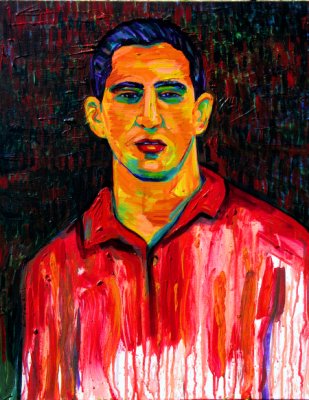 Self-portrait
Tony de Carlo is a native of Los Angeles, California, now residing in New Mexico, between Santa Fe and Albuquerque.
He has been painting every day for the last thirty years. A self-taught artist, he began learning by drawing and painting in journals as a young teenager, each day expressing himself through his visual diaries. Although he abandoned his journals fifteen years ago to work solely on canvas and wood, he continues treating his canvases like pages from his diary, reflecting and expressing his day-to-day life and experiences in his work.
Some of his work mixes religious iconography with homoerotism. Beautiful portraits and other images blend elements of sensuality, religion, spirituality, and nature with Southern Californian, Mexican and Mexican-American ethnic and artistic sensibilities. Tony's extraordinary talent combines these influences and elements, and a brilliant use of colours to produce his unique vision.
Arizona State University (Tempe)
Art Museum of South Texas (Corpus Christi)
California State University Los Angeles
Dezart One Gallery (Palm Springs)
Encantada Gallery of Fine Arts (San Francisco)
Galeria de la Raza (San Francisco)
Jose Galvez Gallery (Tucson)
Liz Blackman Gallery (Hollywood)
Mexican-American Cultural Art Center (Tucson, Arizona)
Mission Cultural Center for Latino Arts (San Francisco)
Palm Springs Desert Museum (California)
Plaza de la Raza (Los Angeles)
The Frye Art Museum (Seattle)
The Mexican Museum (San Francisco)
University of the Arts (Philadelphia)
 Sunflowers in a Blue Vase
Separadores:
Artes
quarta-feira, 25 de outubro de 2006
Latin on Finland's Throne
«Finland's turn at the EU presidency has thrust it into the spotlight – and exposed an uncommon passion – a penchant for Latin.
It is the only country in the world which broadcasts the news in Latin.
On its EU presidency website descriptions of meetings can be read in Latin. And its love of the language of Rome goes deep.
There is a man in the corner of the hotel lounge singing Elvis Presley's songs in Latin, like "Can't Help Falling in Love", or Non adamare non possum.
Or yet…
"Surrender": Nunc æternitatis
"It's Now or Never": Nunc hic aut numquam
"Wooden Heart": Cor ligneum
"Love Me Tender": Tenere me ama
It sounds a little like Italian but rather more stilted – like Italian sung by a foreigner with no ear for Dante's language.
The singer is Dr. Jukka Ammondt. "The legend of Elvis Presley lives for ever, and it's of course very important to sing Elvis Presley's songs in Latin, because it is the eternal language," he says.
Mia Lahti, who edits the EU presidency website, is like many Finns an optimist at heart. But why do a website in Latin?
"The website is in English and French," she says.
But they have their secret language: Conspectus rerum Latinus, or "Latin News in Brief".
"I know there are people who are angry because, for example, in their childhood they had to read compulsory Latin. But also I think it might be interesting to read the news in brief in Latin," Ms Lahti believes.
Lurking within the world of EU Latin, which is only marginally more difficult to comprehend than EU English, is one delightful statistic – more people subscribe to the newsletter in Latin than to the one in French… The Finns are clearly having their revenge on French President Jacques Chirac, who once dismissed their food as the worst in the EU.
The news in Latin on national radio gets 75,000 listeners. "In Latin we have more listeners in the world than for Finnish broadcasts," explains Professor Tuomo Pekannen, who does the translations. "Latin is more known abroad than Finnish," he adds.»
Slightly abridged and adapted from

 Just have a glance at some Finnish words, phrases, and sentences, and decide for yourself what seems to be more difficult - Latin or Finnish.
Mitä kuuluu? – How are you?
Puhutteko englantia? – Do you speak English?
En puhu suomea. – I don't speak Finnish.
Nimeni on RIC, olen portugalilainen ja kotoisin Lissabonista. – My name's RIC, I'm Portuguese, and I'm from Lisbon.
Asun Belémissa, Länsi-Lissabonissa, Tajon joenrannassa (Estorilin ja Cascaisin lähellä). – I live at Belém, in western Lisbon, on the river Tagus's bank (close by Estoril and Cascais).
Just a small grammatical detail: we've always complained about those six dreadful Latin cases (nominative, genitive, accusative, etc.); but if you're thinking about learning some Finnish (a wonderful experience, I assure you!) prepare yourself to deal with those six and… ten more! Yes, the Finnish language has sixteen (16!) cases! A true adventure both for your mind and for your memory…
Now, do you still think learning Latin is an ordeal?...
Separadores:
Linguística
An die Freude / Hino à Alegria / Ode to Joy
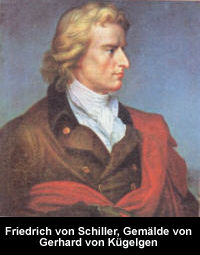
Freude, schöner Götterfunken,
Tochter aus Elysium,
Wir betreten feuertrunken,
Himmlische, dein Heiligtum.
Deine Zauber binden wieder
Was die Mode streng geteilt
Alle Menschen werden Brüder
Wo dein sanfter Flügel weilt.
Johann Christoph Friedrich von Schiller
Alegria, bela centelha divina,
Filha de Elísio,
Penetramos ébrios de fogo,
Celestial, o teu santuário.
Os teus sortilégios reúnem
O que a moda cerce separou.
Todos os homens serão irmãos
Onde a tua meiga asa pousa.
Joy, beautiful spark of Gods,
Daughter of Elysium,
We enter, fire-imbibed,
Heavenly, thy sanctuary.
Thy magic powers re-unite
What custom has stern divided
All men become brothers
Where thy gentle wing abides.

NOTA – A tradução portuguesa não tem qualquer pretensão poética.
O objectivo é tão‑só e apenas o de divulgar o conteúdo da estrofe alemã.
Separadores:
Poesia
terça-feira, 24 de outubro de 2006
Books from all over the world
 As everything else in life, my «20.th Century Novel Top 50» is also reaching the end. Here I leave you the last ten titles.
Marguerite DURAS, L'Amant de la Chine du Nord (France)
Erich Maria REMARQUE, Im Westen nichts Neues (Germany)
Jean-Paul SARTRE, Les Chemins de la Liberté (France)
Luis SEPÚLVEDA, El Viejo Que Leía Novelas de Amor (Chile)
Alexandr SOLJENITSINE, Arkhipelag Gulag (Russia)
John STEINBECK, To A God Unknown (United States of America)
William STYRON, Visible Darkness (United States of America)
Antonio TABUCCHI, Requiem (Italy)
Gonzalo TORRENTE BALLESTER, La Saga/Fuga de JB (Spain)
Virginia WOOLF, Mrs. Dalloway (United Kingdom)
If you're now looking for the complete Top 50, here are the four references to the previous posts:
Julho/18;
Agosto/8;
Agosto/24;
Outubro/9.
I wish I could go a little further from this Top 50 onwards…
I wish you would name a few novels that really were/are quite significant for you on a lifetime scale, so to speak. I'll then try to organise a list of your suggestions and post it.
It would be another way of exchanging ideas and reading experiences.
Thank you.
Separadores:
Literaturas
segunda-feira, 23 de outubro de 2006
Ireland supports gay couples

Dublin – «A new public opinion poll shows the majority of people in Ireland believe same‑sex couples should have the same rights and obligations as married opposite‑sex couples.
But the survey also shows most people do not think same‑sex couples should be allowed to adopt children.
The survey, taken for Dublin's Sunday Tribune, shows that 64% of those polled said they are in favour of gay and lesbian couples having the same legal and financial rights as married couples.
Just over 25% of those surveyed said were against same‑sex couple rights, while about 10% had no opinion.
The poll shows a growing trend toward acceptance of gay and lesbian partners. In February, 51% of those surveyed in a similar poll said they supported legally acknowledging gay couples.
Last January an all party committee of the Irish Parliament recommended legislation to permit civil partnerships similar to those in the UK but rejected the possibility of same-sex marriage.
The Gay and Lesbian Equality Network has been pressing for full marriage rights.
This issue is before Ireland's highest court. The case involves a couple who married in Canada but when they returned home and tried to file a joint income tax return the Revenue Commissioners refused to recognize the marriage citing Irish law. The court heard arguments in the case earlier this month and has reserved judgment.
If the court rules the government must recognize marriages performed in countries where they are already legal it could open a floodgate of couples going to the Netherlands, Belgium or Spain and force the government to bring in full marriage rights rather than civil partnerships.
While public support for same-sex couple recognition continues to grow in Ireland support for gay parenting lags.
The Sunday Tribune poll shows that 50% of those asked about same-sex couples becoming parents said that they oppose the idea. Only 37% were in favour.»
© 365Gay.com
Ireland is on the right path now. Italy seems to be heading that way too. What about Portugal? The Prime Minister should know what he's doing. The problem is I don't believe he does. Better: I don't believe he ever wants to know...
Separadores:
Políticas
domingo, 22 de outubro de 2006
On a gray, rainy day...
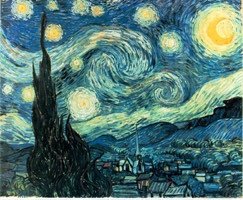
Starry, starry night,
paint your palette blue and grey,
look out on a summer's day,
with eyes that know the darkness in my soul.
Shadows on the hills,
sketch the trees and the daffodils,
catch the breeze and the winter chills
in colors on the snowy linen land.
Now I understand
what you tried to say to me,
and how you suffered for your sanity,
and how you tried to set them free.
They would not listen,
they did not know how,
perhaps they'll listen now.
Starry, starry night,
flaming flowers that brightly blaze,
swirling clouds in violet haze
reflect in Vincent's eyes of China blue.
Colors changing hue,
morning fields of amber grain,
weathered faces lined in pain
are soothed beneath the artist's loving hand.
Now I understand
what you tried to say to me,
and how you suffered for your sanity,
and how you tried to set them free.
They would not listen,
they did not know how,
perhaps they'll listen now.
For they could not love you,
but still your love was true,
and when no hope was left in sight
on that starry, starry night,
you took your life
as lovers often do.
But I could have told you,
Vincent,
this world was never meant
for one as beautiful as you.
Starry, starry night,
portraits hung in empty halls,
frameless heads on nameless walls,
with eyes that watch the world and can't forget.
Like the strangers that you've met,
the ragged men in ragged clothes,
the silver thorn of bloody rose,
lie crushed and broken
on the virgin snow.
Now I think I know
what you tried to say to me,
and how you suffered for your sanity,
and how you tried to set them free.
They would not listen,
they're not listening still,
perhaps they never will…
I'm sure you'll forgive my confessed ignorance.
Hundreds or even thousands of poems may definitely be better, but this one…
… It's hard to see through the falling rain and the tears that go on falling.
Separadores:
Músicas
sábado, 21 de outubro de 2006
«Eu podia chamar-te Pátria minha...»

… Pois podia, mas não chamo. Porque esta belíssima paisagem é propriedade da Porta da Felicidade, a magnificente Istambul. Um bloguista amigo, o Knottyboy, encontra‑se por lá, neste exacto momento. O sortudo… Quem quiser fazer-lhe companhia na maravilhosa viagem só tem de aceder ao blog que ele criou para o efeito: Turkey Trot. É só clicar no nome. E, já agora, deixem-lhe uma palavrinha de incentivo. Eu sei que ele vai adorar…
Em homenagem a tão bom e divertido amigo, aqui publico algumas linhas de algo que está já há algum tempo à espera de ver a luz do dia. Quem sabe se pelo fim do ano…
[…] "Entretanto, ia pensando nas relações que os habitantes das cidades estabelecem com os rios que as banham. Lisboa parece ser um caso especial, talvez só comparável à Istambul do Bósforo e do mar de Mármara. E não será só a localização geográfica que as aproxima, uma protegida por um vasto estuário e a outra encaixada no recorte litoral do Corno de Ouro.
Se Lisboa se pode gabar de ter sido fundada por Ulisses e de ter recebido o privilégio de «Municipium civium Romanorum Olisipo, Felicitas Julia cognominatum» por Júlio César, também Istambul, ou antes Bizâncio, conta com nobres lendas fundadoras. Uma delas reza que Io, amante de Zeus, se transformou em vaca para assim tentar escapar à ira da vingativa esposa Hera, que a fez perseguir por um tavão. Desvairada, Io atravessou o mar a nado, criando o «Βοσπορος» – o Bósforo ou o «vau da vaca» –, antes de prosseguir a fuga para o Egipto, onde foi venerada como Ísis. Nas margens do Corno de Ouro terá dado à luz uma filha, Queroessa, a «sorte bem‑vinda», que foi criada pela ninfa Semestra. Mais tarde, Queroessa deu à luz um filho de Posídon, ao qual deu o nome de Bizas, que foi criado pela náiade Bízia e terá fundado Bizâncio.
Do século IV em diante, os habitantes apenas se lhe referem como a Pólis. Um milénio volvido, quando os Otomanos a conquistam e a nomeiam Porta da Felicidade, capital da Sublime Porta, o que lhes soa como sendo o seu nome é a expressão grega «εις την πόλιν» [isten'polin], «prá cidade», que se tornou aquele que ainda hoje a identifica: Istanbul. Reza a lenda que se percorre a antiga e célebre Mese, a principal artéria bizantina, quando os passos se encaminham para Aya Sofya, a imponente Santa Sofia, ao longo das avenidas Yeni Çeriler Caddesi e Divan Yolu. E hoje, curiosamente, também os turcos özlem duymak, ou seja, sentirão uma espécie de saudade dos áureos tempos otomanos…
E durante alguns séculos, al‑Usbuna foi uma florescente urbe do extremo ocidental do Império Muçulmano. «E tu, nobre Lisboa, que no mundo / Facilmente das outras és princesa / Tu, a quem obedece o Mar profundo» (Luís Vaz de Camões, Os Lusíadas, III.57.1,2 e 5), a teus pés nem o Tejo é já um rio, nem ainda é sobre o Atlântico que te espraias." […]
RIC, De um livro por acabar… / From a book yet to be finished…
This is a humble homage I pay to our blogger friend Knottyboy, who's right this minute in Istanbul, the lucky guy… Just click in «Turkey Trot» above to access his journey blog.
I wish I could have translated this text, but it would take me far too long a time to do it. Those of you, who trust their translator engines, go ahead! Be my guests!
Separadores:
Ficções
This is a Republican / Eis um Republicano

Jesus loves you, and shares your hatred of homosexuals and Hillary.
Jesus ama-te e partilha o teu ódio aos homossexuais e a Hillary Clinton.
Saddam was a good guy when Reagan armed him, a bad guy when Bush's daddy made war on him, a good guy when Cheney did business with him, and a bad guy when Bush needed a "we can't find Bin Laden" diversion.
Saddam era um bom tipo quando Reagan o armou, um bandido quando o papá Bush lhe fez guerra, um bom tipo quando Cheney fez negócios com ele e um bandido quando Bush precisou de uma diversão para "não conseguimos achar o Bin Laden".
Trade with Cuba is wrong because the country is Communist, but trade with China and Vietnam is vital to a spirit of international harmony.
O comércio com Cuba está mal porque o país é comunista, mas o comércio com a China e o Vietname é vital para um espírito de harmonia internacional.
The United States should get out of the United Nations, and our highest national priority is enforcing U.N. resolutions against Iraq.
Os Estados Unidos deveriam abandonar as Nações Unidas, e a nossa maior prioridade nacional é promover as resoluções da ONU contra o Iraque.
A woman can't be trusted with decisions about her own body, but multi-national corporations can make decisions affecting all mankind without regulation.
Não se pode confiar a uma mulher que decida sobre o seu próprio corpo, mas as multinacionais podem tomar decisões que afectam toda a humanidade sem regulamentação.
The best way to improve military morale is to praise the troops in speeches, while slashing veterans' benefits and combat pay.
A melhor forma de elevar o moral militar é elogiar as tropas em discursos, enquanto se cortam os benefícios dos veteranos e o soldo dos combatentes.
If condoms are kept out of schools, adolescents won't have sex.
Se os preservativos forem mantidos fora das escolas, os adolescentes não terão relações sexuais.
A good way to fight terrorism is to belittle our long-time allies, then demand their cooperation and money.
Uma boa forma de combater o terrorismo é apoucar os nossos aliados de sempre e depois pedir‑lhes cooperação e dinheiro.
Providing health care to all Iraqis is sound policy, but providing health to all Americans is socialism. HMOs and insurance companies have the best interests of the public at heart.
Fornecer cuidados de saúde a todos os iraquianos é uma política sólida, mas assegurar a saúde a todos os americanos é socialismo. As organizações de seguros de saúde e as companhias de seguros levam a peito os melhores interesses do público.
Global warming and tobacco's link to cancer are junk science, but creationism should be taught in schools.
O aquecimento global e o nexo entre o tabaco e o cancro são ciência da treta, mas o criacionismo deveria ser ensinado nas escolas.
A president lying about an extra-marital affair is an impeachable offense, but a president lying to enlist support for a war in which thousands (more than half a million by some estimates) die is solid defense policy.
A mentira de um presidente sobre uma relação extra-matrimonial é crime condenável, mas a mentira de um presidente para angariar apoio a uma guerra em que milhares (mais de meio milhão, segundo algumas estimativas) morrem é sólida política de defesa.
Government should limit itself to the powers named in the Constitution, which include banning gay marriages and censoring the Internet.
O governo deveria limitar-se aos poderes consignados na Constituição, que incluem banir casamentos homossexuais e censurar a Internet.
The public has a right to know about Hillary's cattle trades, but George Bush's driving record is none of our business.
O público tem o direito de saber dos negócios de gado de Hillary Clinton, mas o recorde de condução de Bush não nos diz respeito.
Being a drug addict is a moral failing and a crime, unless you're a conservative radio host. Then it's an illness and you need our prayers for your recovery.
Ser‑se toxicodependente é uma falha moral e um crime, a menos que se seja um radialista conservador. Neste caso, é uma doença, e as nossas orações são necessárias à sua recuperação.
What Bill Clinton did in the 60's is of vital national interest, but what Bush did in the 80's is irrelevant.
O que Bill Clinton fez nos anos 60 é de vital interesse nacional, mas o que Bush fez nos anos 80 é irrelevante.
If you don't send it to at least 10 other people, we're likely to be stuck with more Republicans in '06 and '08. Remember; friends don't let friends vote Republican.
Se não enviares a pelo menos mais 10 pessoas, o mais provável é levarmos com mais Republicanos em 2006 e 2008. Lembra-te: os amigos não deixam os amigos votar Republicano.
Separadores:
Políticas
sexta-feira, 20 de outubro de 2006
This world in our eyes...
 Bushs All-Macht-Doktrin
(Auszüge)
Von/By Markus Becker
Bush's Space Power Doctrine
(Excerpts)
«Das amerikanische Militär hat bereits Milliarden von Dollar für die Entwicklung von Waffen ausgegeben, die im Weltraum stationiert werden sollen – darunter Technologie für Attacken auf irdische Ziele und feindliche Satelliten.
"Die Handlungsfreiheit im Weltraum ist für die Vereinigten Staaten genauso wichtig wie die Macht in der Luft und zur See", heißt es in der "National Space Policy". Man werde "andere davon abbringen oder abschrecken", die Ausübung der amerikanischen Rechte im Weltraum zu stören oder auch nur Technologien zu diesem Zweck zu entwickeln.
Man werde "auf Eingriffe antworten" und "falls nötig Gegnern die Benutzung von Weltraumtechnologie untersagen, die US-Interessen feindlich ist".
Mit anderen Worten: Sollte eine andere Nation auch nur den Versuch unternehmen, mit den USA im Weltraum zu konkurrieren, bekommt sie es mit der US-Regierung zu tun.
Bush erteilt in dem Dokument Verteidigungsminister Donald Rumsfeld den Auftrag, Militär- und Spionagetechnologie für den Weltraum nicht nur zu entwickeln, sondern auch einzusetzen.»
The American military already spent billions of dollars on the development of weapons, which are to be stationed in space – among them technology for attacks on terrestrial goals and hostile satellites.
"The freedom of action in space is just as important to the USA as power in air and at sea", stands in the "National Space Policy". "Others will be diverted or deterred from" disturbing the practice of American rights in space or also only from developing technologies for this purpose. One "will answer to interferences" and "if necessary will forbid opponents the use of space technology, which is hostile to the interests of the USA".
In other words, even if another nation should undertake only the attempt to compete with the USA in space, it will have to seriously deal with the USA government.
In the document Bush orders the Secretary of Defense Donald Rumsfeld not only to develop military and espionage technology for space but also to implement it.
… And as all these millions of dollars are being obscenely spent in space jokes, here is what's happening to human lives. Right here on Earth. Right now. According to the Blacksmith Institute these are the "World's 10 Worst-polluted Places":
Chernobyl, Ukraine
Dzerzhinsk, Russia
Bajos de Haina, Dominican Republic
Kabwe, Zambia
La Oroya, Peru
Linfen, China
Mailuu-Suu, Kyrgyzstan
Norilsk, Russia
Ranipet, India
Dalnegorsk and Rudnaya Pristan, Russia
«"Es gibt Städte, in denen die Lebenserwartung mittelalterliches Niveau erreicht, wo Geburtsdefekte der Normfall sind", steht in einer begleitenden Studie, die auch im Internet abrufbar ist. Erst kürzlich hatte die OVN berichtet, dass die Umweltverschmutzung 13 Millionen Menschen im Jahr tötet.»
"There are cities where life expectancy is at medieval level, where birth malformations are the normal case", stands in an accompanying study that can also be looked up in the internet. Only recently the UNO had reported that the environmental pollution kills 13 million humans every year.
... And if we keep in mind that 1/6 of the world population lives in absolute poverty (with less than € 0.80 per day), we won't have such a bright day even if the sun's shining...
Separadores:
Políticas
quinta-feira, 19 de outubro de 2006
Travelling about in Lisbon...
Dear blogger friends (and all visitors are welcome too), let's go for another tour in Lisbon!
 As you're my guests we'll set off from my neighbourhood, Belém. From the top of Belém Tower you're watching that same coastline I saw for the very first time in my life. Different neighbourhoods, all rather close to each other: Belém, Restelo, Pedrouços, Algés, Dafundo… Places I know as well and for as long as I know myself.
 … Now from the top of Discoveries Monument: offer yourselves a moment of pure contemplation: cast your eyes westwards, and you'll be watching that very coastline the brave navigators left 500 years ago. So History is contemplating you as well…
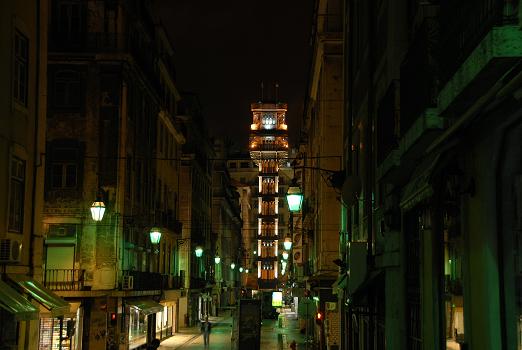 We're downtown now. The 19.th century Santa Justa elevator will take us uptown in a short while, right after sunset. But meanwhile let's…
 … Have a nice cup of coffee in the "Nicola" on the Rossio Square, a Café most celebrated by bohemian poets ever since the 18.th century. Yes, History is all around us… So I believe it's time now to go uptown and…
 Enjoy a wonderful performance at the São Carlos National Opera House. Maria Callas had a huge success here in 1958… You choose your own program for this evening! It's your privilege for being a guest. I'm sure the cast will perform your favourite opera just perfectly…
 Just let your mind fly away and… Watch Lisbon from the air as you're arriving or departing, depending only on your journey's arrangements.
I hope you had a magnificent time and look forward to seeing you all again!
Separadores:
Lisboa
quarta-feira, 18 de outubro de 2006
ClustrMaps™ & NeoCounters…
No, this is no business company I might be trying to advertise. I would never be good at such a job… It's just a point of departure I've found for some reflections of a different kind on being a worldwide blogger. It's quite a unique feeling knowing that you're connected to the whole world.
Honest it is. It may seem tacky to say it this way, and perhaps it is indeed, but as a common human being you only realise the true meaning of such an abstraction when you get evidence of the phenomenon. You don't believe it until you see it. As old as mankind…
So a map and a counter have been giving me enough to think about. Looking at the map I see dots almost everywhere. What can this possibly mean?
First of all, the connection is an obvious reality, regardless of any doubts I might still have. Millions cross the cyberspace at any hour, day or night, searching for each other, hoping perhaps to find a consoling word, an instant of amusement, a soul mate, or a reason of any kind to go on believing in themselves, in others, in life. (Often it's much less serious, I know…)
Taking a closer look I see dots where I never thought I would see any. Not for a reason in particular, no. I suddenly realise I'm still depending on last century's thinking categories, all of them relating to time and space. "If one doesn't travel so often or so easily to such remote places, how come they show up on the map?!" Quite silly, isn't it? Well, I'm not thinking exactly this way, but I guess I'm not that far from it either…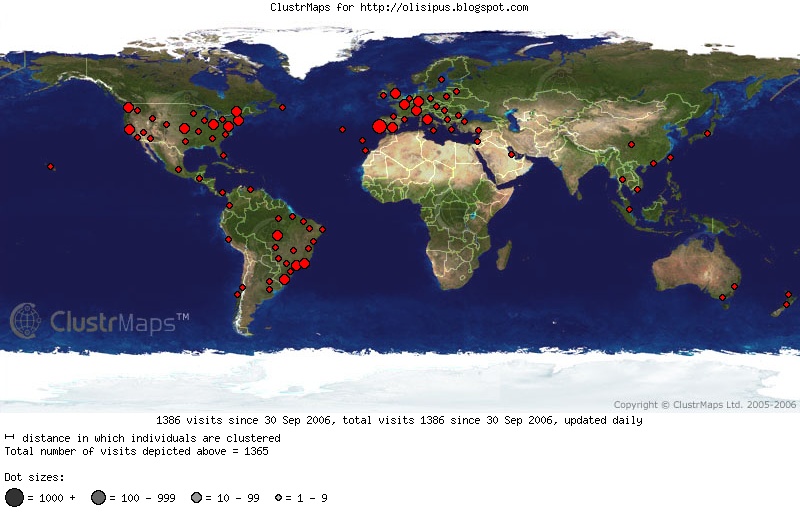 Asia and Oceania would still be a certain kind of mythical places – some Shangri-La or El Dorado: New Zealand, Australia, Japan, China, Taiwan, Singapore, Vietnam, Thailand…
I can't help wondering what those visitors expect to find here, what they think about the blog, about me, what makes them come back and – last but not least – why they come and go so silently. Some are occasional visitors, definitely, people who come across the blog just to find out it's not their cup of tea at all. But I mean those who keep coming, over and over again. Always silently… Not a word…
Central and South America may be a slightly different case. People may just want to take a look out of pure curiosity, I'd say. Brazil is dotted all over, but my contacts are, as far as I know, in Rio de Janeiro and São Paulo. As to all others I haven't a single clue…
Africa is a whole mystery in a certain sense; in another, however, there's no mystery about it at all. A few countries apart, Africa has still a long way to run before taking its due place in the cyberspace. So much is still such top priority that just the thought of being connected to the rest of the world may seem a futile exercise… I wonder whether it truly is.
North America and Europe are the best saved for last. Here too, however, my reflections follow the same path as before: many of those dots are silent places, either in the USA, Canada or Europe. Flags have been being displayed day after day, but their true meaning in this context can only be one and one alone: people just come and go. Well, I guess that's exactly what mankind has always been about anyway, cyberspace or no cyberspace.
One last note: it's quite possible, or almost certain, that most people don't like what they see or read. That's okay with me as well. I've never claimed I was here to please both Greeks and Trojans, have I?
Separadores:
Geografias