segunda-feira, 25 de dezembro de 2006

«Have Yourself A Merry Little Christmas»

Have yourself a merry little Christmas,
Let your heart be light,
From now on,
Our troubles will be out of sight.

Have yourself a merry little Christmas,
Make the Yule-tide gay,
From now on,
Our troubles will be miles away.

Here we are as in olden days,
Happy golden days of yore.
Faithful friends who are dear to us
Gather near to us once more.

Through the years
We all will be together,
If the Fates allow.
Hang a shining star upon the highest bough,
And have yourself a merry little Christmas now.

The heart warming Christmas song "Have Yourself A Merry Little Christmas" was immortalised by Judy Garland when she sang this song to Margaret O'Brien and brought tears to the eyes of the audience.

– … And it still brings! I cannot help them every single time I listen to it.

The lyricist for "Have Yourself A Merry Little Christmas" was Ralph Blane and the haunting music was composed by Hugh Martin.

– God bless them! Geniuses, no doubt!

The song "Have Yourself A Merry Little Christmas" was first published in 1943.

– Oh my God, my Mother was only thirteen years old!

"Have Yourself A Merry Little Christmas" is undoubtedly one of the saddest Christmas songs of the century.

– In 1943 what else could be expected if the whole world was at war? And yet it still is one of the most beautiful ever… I'm right now listening to the version sung by Rosemary Clooney. Heavenly delicious! Join me on this Christmas Day!

Para todos vós, queridos amigos, vai o meu pensamento e os meus votos de um reconfortante Dia de Natal.
RIC

domingo, 24 de dezembro de 2006

Thank you all for making my Christmas brighter!

My last post before the Holy Night.

Ever since I know myself, I've always been very susceptible on the days around Christmas…
I hear a child singing, and I cry;
I listen to a Christmas song, and I cry;
I watch a movie, and I cry;
I think about Christmases of years long gone by, and I cry;
I remember my Mother when I was a child, and I cry;
I read some comments on this blog, and I cry;
I get any anodyne post or any simple e-mail, and I cry;
I'm writing these lines, and I'm crying…
I try not to, of course.
I just cannot help it.
I thank you all for making me feel alive again.
I thank you all for making my Christmas brighter.
I wish you all a


Merry Christmas!

Feliz e Santo Natal!

Para todos quantos me acompanham desde Julho.
Obrigado pela preciosa ajuda que me têm dado.
Sem o saberem, acredito.
Aos que são crentes, que Deus vos ajude.
Graças a todos vós, o Mundo ganhou novas cores.
Como estas imagens com que vos deixo.


A marvellous space for the Midnight Mass...
Um excelente espaço para a Missa do Galo...

RIC

sábado, 23 de dezembro de 2006

«Adeste Fideles»

"Adeste Fideles" or "O Come All Ye Faithful" is a Christmas carol which is commonly believed to have been composed by John Francis Wade in approximately 1743.

John Wade was a Catholic layman and a music teacher, who fled England after the Jacobite rebellion of 1745. He went to the English College, Douai, which was a refuge for British Catholics after the abdication of James II in 1688.

The words may therefore be attributed to Wade or to others, but certainly originate amongst exiled Jacobite Roman Catholics of the 1740s. The earliest existing manuscript shows both words and tune. It was published in the 1760 edition of Evening Offices of the Church. John Francis Wade included it in his own publication of "Cantus Diversi" (1751).

The title "Adeste Fideles" is usually reserved for the Latin original and "O Come All Ye Faithful" for the English translation.

It is sometimes referred to as the "Portuguese Hymn" as it was often sung in the Portuguese Embassy in London where Vincent Novello was organist.

The lyrics and music of "Adeste Fideles" have also been attributed to King John IV of Portugal – D. João IV, a musician himself and an excellent composer. It has also on occasions been erroneously attributed to Saint Bonaventure (13.th century).

In the United Kingdom it is most often sung today in an arrangement by Sir David Willcocks, published in the Oxford Carols for Choirs series.

The final verse "Yea, Lord, we greet thee, born this happy morning" is generally omitted before Christmas day, a notable exception being the traditional midnight mass.


"Venite adoremus Dominum."

First stanza (Latin and English)

Adeste fideles, læti, triumphantes
(Be present, faithful, joyful, triumphant)

Venite, venite in Bethlehem
(Come, come into Bethlehem)

Natum videte, Regem angelorum
(Behold the Newborn, King of angels)

Venite adoremus, venite adoremus
(Come, let us adore; come, let us adore)

Venite adoremus Dominum.
(Come, let us adore the Lord).

Latin

Deum de Deo, Lumen de Lumine,
Gestant puellæ viscera,
Deum verum, Genitum non factum.
Venite adoremus, venite adoremus,
Venite adoremus Dominum

In grege relicto, Humiles ad cunas
Vocati pastores approperant.
Et nos ovanti, Gradu festinemus;
Venite adoremus, venite adoremus,
Venite adoremus Dominum

Cantet nunc Io chorus Angelorum;
Cantet nunc aula cælestium:
Gloria in excelsis Deo.
Venite adoremus, venite adoremus,
Venite adoremus Dominum.

Stella duce, Magi Christum adorantes,
Aurum, tus et myrrham dant munera.
Iesu infanti corda præbeamus;
Venite adoremus, venite adoremus,
Venite adoremus Dominum.

Æterni Parentis splendorem æternum
Velatum sub carne videbimus:
Deum Infantem, pannis involutum,
Venite adoremus, venite adoremus,
Venite adoremus Dominum.

Pro nobis egenum et fœno cubantem
Piis foveamus amplexibus:
Sic nos amantem quis non redamaret?
Venite adoremus, venite adoremus,
Venite adoremus Dominum.

Ergo qui natus die hodierna,
Iesu, tibi sit gloria,
Patris æterni Verbum caro factum.
Venite adoremus, venite adoremus,
Venite adoremus Dominum.

Adeste, fideles, adoremus Dominum
Adeste, fideles!

English

O come all ye faithful
Joyful and triumphant
O come ye, o come ye to Bethlehem
Come and behold Him
Born the King of Angels
O come let us adore Him (3×)
Christ the Lord

God of God
Light of Light,
Lo, he abhors not the Virgin's womb;
Very God, begotten not created.
O come let us adore Him (3×)
Christ the Lord

See how the shepherds,
Summoned to His cradle,
Leaving their flocks, draw nigh to gaze;
We too will thither
Bend our joyful footsteps;
O come let us adore Him (3×)
Christ the Lord

Lo! star led chieftains,
Magi, Christ adoring,
Offer Him incense, gold, and myrrh;
We to the Christ Child bring our hearts' oblations.
O come let us adore Him (3×)
Christ the Lord

Splendour Immortal,
Son of God Eternal,
Now hidden in mortal flesh our eyes shall view.
See there the Infant, swaddling clothes enfold him.
O come let us adore Him (3×)
Christ the Lord

Child, for us sinners
Poor and in the manger,
We would embrace Thee, with love and awe;
Who would not love Thee, loving us so dearly?
O come let us adore Him (3×)
Christ the Lord

Sing! Choirs of Angels;
Sing in exaltation,
Sing, all ye citizens of heaven above;
Glory to God, in the highest
O come let us adore Him (3×)
Christ the Lord

Yea, Lord, we greet thee!
Born this happy morning,
Jesus, to Thee be glory given;
Word of the Father,
Now in flesh appearing:
O come let us adore Him (3×)
Christ the Lord.

(Adapted and edited from Wikipedia)

sexta-feira, 22 de dezembro de 2006

Winter, Sintra & Lord Byron…

Scarcely has winter arrived, yet its influence is to be felt all over the country as if it were mid January already. Freezing temperatures everywhere, a beautiful clear blue sky, and the sun shining so brightly one should really wear sunglasses are to be expected until after Christmas.

This is a welcome invitation for us (me and you, blogger friends and readers) to leave Lisbon and go for a stroll in Portugal's capital of Romanticism – Sintra. And who else could be our international perfect guide but Lord Byron?
"Lo! Sintra's glorious Eden intervenes
In variegated maze of mount and glen.
Ah me! what hand can pencil guide, or pen,
To follow half on which the eye dilates
Through views more dazzling unto mortal ken
Than those whereof such things the bard relates,
Who to the awe-struck world unlocked Elysium's gates?
"

in "Childe Harold's Pilgrimage"

In a letter to Francis Hodgson dated July 16.th, 1809, Lord Byron also says:

"I must just observe that the village of Sintra in Estremadura [Portugal's province] is the most beautiful, perhaps in the world. I am very happy here, because I loves oranges and talk bad Latin to the monks, who understand it, as it is like their own [language], and I goes into society (with my pocket pistols)…"

National Palace (former Royal residence)

Pena Palace (19.th century)

Pena Palace (air view)

Moorish Castle

These photos may not do entire justice to all of the beauties of this piece of Paradise, but some romantic imagination is here best in place – locus amœnus as a romantic state of mind, as a condition of the romantic soul…

Enjoy it lavishly! This is my Christmas present for all of you.

RIC

quinta-feira, 21 de dezembro de 2006

II. «Natal»


Natal… Na província neva.
Nos lares aconchegados,
Um sentimento conserva
Os sentimentos passados.

Coração oposto ao mundo,
Como a família é verdade!
Meu pensamento é profundo,
Estou só e sonho saudade.

E como é branca de graça
A paisagem que não sei,
Vista de trás da vidraça
Do lar que nunca terei.

in «Notícias Ilustrado», n.º 29, de 3-12-1928

[Obras de Fernando Pessoa,
vol. I, pp. 251-2, Lello & Irmãos – Editores]

I. Far away from home…

As we approach Christmas Day I cannot help thinking about those who – either willingly or unwillingly – are about to spend the Magic Night and the Joyful Day far away from their homes and from their beloved ones.

There are Portuguese in several parts of the world – Bosnia, Kosovo, Lebanon, Afghanistan, East-Timor, as there are also British, Americans, Canadians, French, Germans, Italians, Spaniards, other nationalities, for sure, in other parts as well.

Although I've always been a genuine pacifist, Christmas is the right moment for me to think of those who mainly are most of the time pawns in others' games and schemes. Yes, cannon meat! Some hours ago I heard in the news G. W. Bush is sending more young Americans to Iraq…

It's a shame, and yet true – oh so true – that so many people still don't want to know the meaning of "Give Peace a Chance".


By Michael Marks
December 7.th, 2000

«The embers glowed softly, and in their dim light,
I gazed round the room and I cherished the sight;
My wife was asleep, her head on my chest,
My daughter beside me, angelic in rest.

Outside the snow fell, a blanket of white,
Transforming the yard to a winter delight;
The sparkling lights in the tree, I believe,
Completed the magic that was Christmas Eve.

My eyelids were heavy, my breathing was deep,
Secure and surrounded by love I would sleep
In perfect contentment or so it would seem,
So I slumbered, perhaps I started to dream.

The sound wasn't loud, and it wasn't too near,
But I opened my eye when it tickled my ear;
Perhaps just a cough, I didn't quite know,
Then the sure sound of footsteps outside in the snow.

My soul gave a tremble, I struggled to hear,
And I crept to the door just to see who was near;
Standing out in the cold and the dark of the night,
A lone figure stood, his face weary and tight.

A soldier, I puzzled, some twenty years old,
Perhaps a Marine, huddled here in the cold;
Alone in the dark, he looked up and smiled,
Standing watch over me, and my wife and my child.

"What are you doing?" I asked without fear,
"Come in this moment, it's freezing out here!
Put down your pack, brush the snow from your sleeve,
You should be at home on a cold Christmas Eve!"

For barely a moment I saw his eyes shift
Away from the cold and the snow blown in drifts
To the window that danced with a warm fire's light,
Then he sighed and he said "It's really all right,
I'm out here by choice. I'm here every night.

"It's my duty to stand at the front of the line
That separates you from the darkest of times;
No one had to ask or beg or implore me,
I'm proud to stand here like my fathers before me.

"My Gramps died at 'Pearl' on a day in December,"
Then he sighed, "That's a Christmas 'Gram' always remembers;
My dad stood his watch in the jungles of 'Nam,
And now it's my turn and so, here I am.

"I've not seen my own son in more than a while,
But my wife sends me pictures, he's sure got her smile;"
Then he bent and he carefully pulled from his bag,
The red white and blue... an American flag.

"I can live through the cold and the being alone
Away from my family, my house and my home;
I can stand at my post through the rain and the sleet,
I can sleep in a foxhole with little to eat.

"I can carry the weight of killing another
Or lay down my life with my sisters and brothers
Who stand at the front against any and all,
To insure for all time that this flag will not fall.

"So go back inside," he said, "harbor no fright,
Your family is waiting and I'll be all right."

"But isn't there something I can do, at the least
Give you money," I asked, "or prepare you a feast?
It seems all too little for all that you've done,
For being away from your wife and your son."

Then his eye welled a tear that held no regret,
"Just tell us you love us, and never forget
To fight for our rights back at home while we're gone,
To stand your own watch, no matter how long.

"For when we come home, either standing or dead,
To know you remember we fought and we bled
Is payment enough, and with that we will trust
That we mattered to you as you mattered to us."»

(http://grunt.space.swri.edu/mmsolchr.htm)

Thank you very much, Gray, for the inspiration! I certainly wouldn't have thought of it any other way.

RIC

quarta-feira, 20 de dezembro de 2006

II. Et homo factus est


Et incarnatus est de Spiritu Sancto…

And was made flesh of Spirit Holy…
E encarnou pelo Espírito Santo…
Hat Fleisch angenommen durch den Heiligen Geist…
Par l'Esprit Saint, il a pris chair…

… ex Maria Virgine. Et homo factus est.

… of Mary Virgin. And was made man.
… no seio da Virgem Maria e se fez homem.
… von der Jungfrau Maria und ist Mensch geworden.
… de la Vierge Marie, et s'est fait homme.

in Credo

Grand Mass in C minor, Wolfgang Amadeus Mozart -
- "Et incarnatus est" (8')

… If you don't know it, if you've never listened to it, I'm absolutely sure you have no idea at all of all the beauty you are missing…

RIC

I. Palavras que avivam o meu fascínio pelo Alemão…

Streichholzstächelchen:
Pauzinho de fósforo.

Geschwindigkeitsbegrenzung:
Limitação de velocidade.

Bundesausbildungsförderungsgesetz:
Lei federal de fomento da formação.

Donauflußdampfschifffahrtsgesellschaft:
Sociedade de navegação fluvial a vapor do Danúbio.

Nachmittagskinderunterhaltungsprogramm:
Programa vespertino de entretenimento infantil.

Rindfleischetikettierungsüberwachungsaufgaben-

übertragungsgesetz !!!


Pelos deuses do Olimpo que alto moram! Esta é que é um genuíno bico de obra! Tinha de vir do sector jurídico… Mas vamos por partes. Primeiro, com alguma ajuda da Altavista, em Inglês e Francês, respectivamente, será:

Law of transmission of the monitoring tasks of beef labelling.
Loi de transfert des tâches de surveillance d'étiquetage de viande bovine.

Então, eis uma proposta para o Português:
Lei de transmissão das tarefas de supervisão da etiquetagem de carne bovina.

Livra! Custou, mas lá saiu…
Como é que uma «designação» destas não haveria de pôr o «Landtag» (Parlamento) do Estado federal do Meclemburgo-Cis‑Pomerânia em peso a rir a bandeiras despregadas?!… Nem mesmo depois de ter traduzido tenho a certeza de perceber o que realmente quer dizer… E o meu convívio constante com a língua alemã remonta a 1974!

Esta «palavra» é de 1999, e foi nesse mesmo ano proposta pela Sociedade de Língua Alemã para a escolha da Palavra do Ano. Pudera!…

RIC

terça-feira, 19 de dezembro de 2006

II. Um Mimo de "Même"... de A a Z

A de Amor (frase curta): – É fogo que arde em pouco tempo.

B do Beijo mais recente: – Há já algum tempo.

C da Cidade natal: – Lisboa.

D do Defeito: – Auto‑suficiência.

E de Estado civil: – Solteiríssimo.

F de Fobias: – Multidões.

G de Gostos inconfessos: – Sexo na praia.

H da Hora de levantar: – Tarde.

I de Instrumento musical tocado: – Nenhum.

J do Jogo favorito: – "Trivial Pursuit".

L de Lamento verbalizado: – Pois é…

M de Manias: – Disposição metódica de objectos.

N do Nome do melhor amigo: – Z. L.

O do Objecto fundamental de uso diário: – Maço de cigarros.

P do Prato mais bem preparado: – Omeleta com todos.

Q da Qualidade: – Lealdade.

R de Radiografias feitas: – Pulmões e dentes (muitas).

S do Sumo preferido: – Maçã.

T de Tamanho (de roupa…): – M e, às vezes, L.

U de Utopia: – Sempre! É pelo sonho que vamos…

V de Vegetais preferidos: – Cenoura, couve‑flor, brócolos.

X de Xixi na cama: – Nunca.

Z do Zodíaco: – Touro.

Se quiserem adoptar o figurino e vesti‑lo com as vossas indumentárias, não se acanhem! Sirvam‑se à vontade! É todo vosso!
(Deixem uma palavrinha! Só para eu depois ver como fica…)

Thank you, Joël, for the original meme! As you say, it is great fun…

RIC

I. The theme song of your life is…

… No. 1 song on the charts on your birthday or on your 18.th birthday, depending on the year you were born!
Just to increase the probabilities, check out both charts – UK and USA.
So first let's go to

http://www.thisdayinmusic.com/member/birthdayno1.php

"What was no.1 on the day you were born?"
Let's try it!

On my birthday:
It Doesn't Matter Anymore – Buddy Holly (UK)
The Happy Organ – Dave 'Baby' Cortez (USA)

I have no recollection whatsoever of having ever heard those two songs. Strange, being so much into oldies as I am…

On my 18.th birthday:
Free – Deniece Williams (UK)
When I Need You – Leo Sayer (USA)

Some bells have just started ringing: I've got some idea of "Free", but "When I Need You" can be considered, if not the, at least one of the theme songs of my life… And how!

"When I need you
I just close my eyes and I'm with you,
And all that I so want to give you,
It's only a heartbeat away.

When I need love
I hold out my hands and I touch love,
I never knew there was so much love
Keeping me warm night and day.

Miles and miles of empty space in between us,
The telephone can't take the place of your smile,
But you know I won't be travelin' forever.
It's cold out, but hold out, and do like I do.

When I need you
I just close my eyes and I'm with you,
And all that I so wanna give you babe
It's only a heartbeat away.

It's not easy when the road is your driver,
Honey, that's a heavy load that we bear
But you know I won't be traveling a lifetime.
It's cold out but hold out and do like I do
Oh, I need you.

When I need love
I hold out my hands and I touch love,
I never knew there was so much love
Keeping me warm night and day.

When I need you
I just close my eyes
And you're right here by my side
Keeping me warm night and day.

I just hold out my hands
I just hold out my hand
And I'm with you darlin',
Yes, I'm with you darlin'.
All I wanna give you
It's only a heartbeat away
Oh I need you darling."

Thanks a lot, Gumby! This was a fine idea indeed!

segunda-feira, 18 de dezembro de 2006

Da Língua Portuguesa (4)


"Ein jeder, weil er spricht, glaubt, auch über die Sprache sprechen zu können."

Qualquer um, porque fala, julga que também sabe falar sobre a língua.

Johann Wolfgang von Goethe

Acentuação dos advérbios em
"-mente" e de formas do Presente simples do Conjuntivo

«Estudei até ao antigo 11.º Ano na Área de Humanísticas.
Actualmente, sou formanda de um curso de qualificação profissional no Instituto de Emprego e Formação Profissional de Setúbal e no âmbito do mesmo tenho aulas de Português.
Pelo menos duas vezes, fui confrontada com ensinamentos que não me parecem correctos, tanto quanto me lembro das minhas aulas de Português na escola secundária.
Primeira: a formadora diz‑nos que "raramente" é uma palavra esdrúxula. Recordo ainda a minha excelentíssima professora da Escola Secundária, Dr.ª Ana Maria Parente, dizendo‑nos que todos os advérbios de modo são palavras graves. Não importa de que adjectivo venham; ao transformarem‑se em advérbios de modo, a sílaba tónica passa a ser "-men-", a penúltima, e, portanto, são palavras graves.
Confrontei a actual formadora com tal facto, e a referida senhora, não muito segura, informou‑me de que iria verificar no prontuário. Dias depois, reiterou perante a turma que "raramente" é efectivamente uma palavra esdrúxula.
Continuo céptica. Por favor, esclareçam‑me!

Segunda: esta senhora pôs‑nos hoje a completar frases com o presente do conjuntivo de alguns verbos. Uma das frases compreendia a primeira pessoa do plural do verbo "conseguir", que ela completou com "consígamos" (até o corrector ortográfico do computador discorda!). Mais uma vez, recordo a Dr.ª Ana Maria Parente dizendo-nos:
– Meninos! Não é "fáçamos", "tênhamos" ou "póssamos". É "façamos", "tenhamos" e "possamos".
Seguindo essa regra, será então "consigamos". Esta já eu verifiquei na vossa página e efectivamente não vejo acento no -i-. Mas, já agora…»

Palavras para quê?
A referida formadora é uma "artista" portuguesa que tudo deve à opulenta ignorância em que vive prazenteiramente atolada! Abençoada seja!
Pelos deuses do Olimpo que alto moram, ignorar as regras básicas de acentuação?! Será possível que a dita formadora não tenha sequer completado o 1.º ciclo do ensino básico?
Ou será analfabeta funcional? Há tantos por aí...
"Anda sob capa de letrado muito asno disfarçado" é um provérbio tão antigo…
Pobre formanda, que tem de se confrontar com quem é ignorante e não quer saber que qualquer aula se prepara – SEMPRE!

Aplica-se aqui um neologismo que só professores/formadores ignaros, incompetentes e irresponsáveis poderão conjugar:
"Que desensinemos quem já sabe é‑nos indiferente!"
[A sílaba tónica é "-ne-", já se vê, e a respectiva vogal, semiaberta.
"Desensinemos" é, pois, uma palavra grave ou paroxítona.]

Se não tivesse encontrado este apelo na nova secção de Linguística do "Público", juro pelos supracitados deuses que, se mo contassem, não acreditaria!
Uma coisa é certa: a formanda sabe mais Português do que a formadora de Português. Curioso facto…
Que raio é que está a passar‑se neste nosso País?!
Estaremos já na vanguarda das estatísticas relativas ao consumo absoluto de álcool per capita?
Bem, alguma vez há‑de ser a primeira em que haveremos de ser os primeiros em alguma coisa…
Magnanimamente!

RIC

domingo, 17 de dezembro de 2006

II. Ban death penalty, for Heaven's sake!

"Washington – Zumindest vorerst hat der Gouverneur von Florida, Jeb Bush, die Vollstreckung von Todesstrafen mit der Giftspritze für die kommenden Monate ausgesetzt. Es drohe sonst die Verletzung der Verfassungsrechte, sagte der Bruder des Präsidenten George W. Bush laut MSNBC in Miami. Eine Untersuchungskommission soll nun bis Anfang März prüfen, ob Hinrichtungen mit Giftspritzen überhaupt verfassungsgemäß sind. Allein in Florida warten nach Medienberichten derzeit 374 Menschen auf die Todesstrafe in den Gefängnissen.
Hintergrund ist die schwere Panne bei der Hinrichtung des 55-jährigen Angel Nieves Diaz in der vergangenen Nacht. Er war erst nach qualvollen 34 Minuten gestorben. Normalerweise dauere es "wesentlich kürzer", wurde der Gefängnisarzt zitiert.
Diaz war 1979 wegen eines Mordes zum Tode verurteilt worden."


Die Tochter und die Schwester des Angel Nieves Diaz während seiner Hinrichtung vor dem Gefängnis.
Angel Nieves Diaz' daughter and sister outside the prison during his execution.

Washington – At least for the time being, Florida's governor, Jeb Bush, has suspended the enforcement of death penalties by lethal injections for the coming months. Otherwise an injury of the constitutional rights may be a threat, said President George W. Bush's brother, according to MSNBC in Miami. A commission of inquiry has now to examine until the beginning of March whether executions by lethal injections are at all constitutional. Alone in Florida 374 people are waiting at present for the death penalty in prisons, according to media reports.
The motive of the suspension is the heavy breakdown during the execution of the 55 year old Angel Nieves Diaz last night. He died only after some excruciating 34 minutes. Normally it lasts "substantially less time", said the prison doctor.
Diaz had been condemned to death in 1979 because of a murder.

Did this happen in today's United States of America or in Pinochet's Chile?
Has Fidel Castro been doing the same in Cuba?
What on earth is going on in Guantánamo?
I was looking for some information on Peace Vigils all over the world today, when I came across this barbaric news.
So much for my peace thoughts…

RIC

I. Rainer Maria Rilke (4)


Archaischer Torso Apollos

Wir kannten nicht sein unerhörtes Haupt,
darin die Augenäpfel reiften. Aber
sein Torso glüht noch wie ein Kandelaber,
in dem sein Schauen, nur zurückgeschraubt,

sich hält und glänzt. Sonst könnte nicht der Bug
der Brust dich blenden, und im leisen Drehen
der Lenden könnte nicht ein Lächeln gehen
zu jener Mitte, die die Zeugung trug.

Sonst stünde dieser Stein entstellt und kurz
unter der Schultern durchsichtigem Sturz
und flimmerte nicht so wie Raubtierfelle;

und bräche nicht aus allen seinen Rändern
aus wie ein Stern: denn da ist keine Stelle,
die dich nicht sieht. Du mußt dein Leben ändern.

Archaic Torso of Apollo

We cannot know his legendary head
with eyes like ripening fruit. And yet his torso
is still suffused with brilliance from inside,
like a lamp, in which his gaze, now turned to low,

gleams in all its power. Otherwise
the curved breast could not dazzle you so, nor could
a smile run through the placid hips and thighs
to that dark center where procreation flared.

Otherwise this stone would seem defaced
beneath the translucent cascade of the shoulders
and would not glisten like a wild beast's fur:

would not, from all the borders of itself,
burst like a star: for here there is no place
that does not see you. You must change your life.

(Translated by Stephen Mitchell)

Dem lieben Freund und Künstler Hans Sfiligoi
und seinem prachtvollen, wunderschönen Werk gewidmet.

Dedicado ao querido amigo e artista Hans Sfiligoi
e à sua obra esplêndida e maravilhosa.

Dedicated to the dear friend and artist Hans Sfiligoi
and to his splendid, marvellous work.

RIC

sexta-feira, 15 de dezembro de 2006

II. Da Morte


Não tenho como evitar voltar ao assunto.

Depois de ter escrito a mensagem de despedida e de a ter traduzido para Inglês, qualquer coisa ficou por dizer. Não sei se vou encontrá‑la, ao escrever agora em Português, mas sinto que tenho de escrever.

Quando abri a caixa de correio e vi o nome – Hans Sfiligoi –, o meu primeiro pensamento foi: "O Hans voltou à blogosfera!" E fiquei contente. Não sabia que ele estava doente. Não sabia que a sua doença era tão séria. Não sabia que era terminal. Cancro pulmonar. Percebi de imediato, ao ler a causa do falecimento no e-mail enviado pelo filho, a reacção que ele tivera ao ler, num édito meu de Julho, que fumo relativamente bastante. Se é que isto é Português de gente, relativamente bastante… Ele sabia já que "relativamente bastante" tivera para ele consequências nefastas.

Tenho uma atitude muito pouco compreensível, talvez até muito estranha, no tocante a doenças. Nunca acredito, isto é, nunca me convenço de que alguém vá morrer em consequência de uma doença. Mesmo que esteja numa cama de hospital, e outros se dêem ao trabalho de me fazer ver que a situação é grave. Na infância, cheguei a pensar que os adultos choravam os mortos porque tinham medo de morrer a seguir… Choravam de medo, não de desgosto. Depressa percebi que estava enganado. Em breve, familiares e amigos começaram a partir, e eu vivi por dentro os choros dos outros demasiadas vezes.

Hoje, não há praticamente ninguém na minha vida que possa partir e com isso aumentar o meu desgosto acumulado pelas sucessivas partidas ao longo dos últimos quinze anos. Amizades e relacionamentos de anos bruscamente interrompidos. Despedidas que não aconteceram. Lutos que se atropelaram. Pensava eu que não. A prova está aí. Alguém com quem partilhava umas quantas afinidades, cujo trabalho muito apreciava, com quem trocara uns quantos longos e-mails sobre as nossas vidas, as nossas convicções, os nossos gostos e desgostos. De meados de Julho ao fim de Setembro. Sinto‑me destroçado. De novo.

Segundo o filho, o Hans faleceu em Viena no passado dia 28 de Novembro. Procurando não sei bem o quê, fui ver o que havia editado nesse mesmo dia: "Pour faire le portrait d'un oiseau", de Jacques Prévert. Creio que tem tudo que ver com ele. Mesmo sem ter ido verificar, lembrei‑me de que o Hans fazia parte do grupo dos pouquíssimos que comentavam os meus poucos éditos em Francês. Além de emérito artista plástico, era um poliglota com uma licenciatura em Eslavística e um cidadão profundamente comprometido com as justas causas da nossa época.

Querido Hans, onde quer que estejas, descansa em paz e vela por nós. O nosso encontro foi fugaz, mas deixaste, ainda assim, uma belíssima marca da tua profunda humanidade no meu coração. Bem hajas por teres estado entre nós.

RIC

I. Hans Sfiligoi, a.k.a. Castor, in Memoriam


Mein recht lieber Freund Hans!

Heute habe ich die traurigste Nachricht in Lissabon erhalten.

Verzeihe es mir, mein lieber Hans, ich wußte es aber nicht. Ich bin erschüttert.

Du wirst in meinem Herzen bleiben, und da wirst Du für immer leben.

Deine prachtvolle Kunst wird Deine Geschichte tausendfach immer wieder erzählen.

Deine Familie, der ich so dankbar dafür bin, dass sie mir die Nachricht hat zukommen lassen, ist Deine natürliche Fortsetzung und wird in Ehre Deines gedenken.

Genau wie wir alle Blogger-Freunde, die die erhabene Ehre hatten, Dich je kennengelernt zu haben.

Sei recht lieb gegrüßt, lieber Freund!
Dein

João Ricardo

R. I. P.

My dearest friend Hans,
Today I received the saddest message in Lisbon.
Forgive me, my dear Hans, but I didn't know. I am in pain.
You will remain in my heart, and there you will always live. Forever.
Your marvellous art will tell your history many, many times, again and again.
Your family, to which I am so grateful for the fact that I was sent the message, is your natural continuation, and in honour will be thinking of you.
Exactly as we all are, your blogger friends, who had the raised honour to have become acquainted with you.
Be dearly greeted, dear friend!

R. I. P.

quinta-feira, 14 de dezembro de 2006

De Gil Vicente um pouco…


"Esta perfiguração se escreve neste primeiro livro nas obras de devação, porque a segunda e a terceira parte forão representadas na capella; mas esta primeira foi representada de camara, pera consolação da muito catholica e sancta Rainha Dona Maria, estando inferma do mal de que falleceu, na era do Senhor de 1517."

[…]
Vem um Parvo, e diz ao Arrais do Inferno:


PARVO
Hou daquela!

DIABO
Quem é?

PARVO
Eu sou. É esta a naviarra nossa?

DIABO
De quem?

PARVO
Dos tolos.

DIABO
Vossa. Entrai!

PARVO
De pulo, ou de voo? Oh pesar de meu avô! Soma vim adoecer, e fui má‑hora morrer, e nela pera mi só.

DIABO
De que morreste?

PARVO
De quê? Samicas de caganeira.

DIABO
De quê?

PARVO
De caga merdeira! Má rabugem que te dê!

DIABO
Entra, e põe aqui o pé!

PARVO
Hou lá! Não tombe o zambuco!

DIABO
Entra, tolaço eunuco, que se nos vai a maré!

PARVO
Aguardai, aguardai, hou lá! E onde havemos nós d'ir ter?

DIABO
Ao porto de Lucifer.

PARVO
Ha-á-a…

DIABO
Ó Inferno. Entra cá!

PARVO
Ó Inferno?… Eramá… Hiu! Hiu! Barca do cornudo, beiçudo, beiçudo! Rachador d'Alverca, huhá! Sapateiro da Landosa! Antrecosto de carrapato! Hiu! Hiu! Caga no sapato, filho da grande aleivosa! Tua mulher é tinhosa e há-de parir um sapo chantado no guardanapo! Neto de cagarrinhosa!
Furta cebolas! Hiu! Hiu! Excomungado nas igrejas! Burrela, cornudo sejas! Toma o pão que te caiu! A mulher que te fugiu pera a Ilha da Madeira! Ratinho da Giesteira! Cornudo atá mangueira! Toma o pão que te caiu! O demo que te pariu!
Hiu! Hiu! Lanço-te uma pulha! De pica nàquela! Hiu! Hiu! Caga na vela! Cabeça de grulha! Perna de cigarra velha, caganita de coelha, rabo de forno de telha, pelourinho da Pampulha! Mija n'agulha, mija n'agulha!
[…]

in "Auto da Barca do Inferno"

"… Abençoados os pobres de espírito…"

quarta-feira, 13 de dezembro de 2006

Interview with the… blogger


Name: Ric Bloggable
Age: <>Location: Lisbon, Portugal, EU
Vocation: Being good at and doing well what some consider being quite dispensable…
Life Philosophy: I live and let live, and I'll be learning till the day I die.

– Sum up what your blog is about.
"Everything on my blog can become subject. From life in the past to lives in the present; from day-to-day life to scientific discoveries. Get in and read – I am here also for you all. From great new books to music and cinema revelations; from world events to my own points of view; from beauty and solace to language variation. You are heartily welcome! This is a blog to and for Europe, together with the World." [Banner text]

– Why did you decide to create a blog?
I'm curious about anything that has to do with reading, writing, editing, publishing, sharing ideas and opinions, being better informed, enhance knowledge, knowing people – all of which also happens in the bloggosphere.

– What's the funniest article on your blog?
I really don't know. There may be a few among more than 200. But I'm not looking for fun. Fun is not appealing to me at all.

– What keeps you motivated to keep adding posts?
I believe it's the relationships I've been developing for the last few months. All of the sudden I surprise myself thinking about what would be interesting to post about (from my perspective), but that might be also interesting and appealing to A, B, C, or all of them at once. And there are galaxies of subjects to post about…

– Do you envy any other blogs?
Envy has never had a place in my life. Some times I just happen to read others' posts and wonder whether I'd ever come up with such great ideas or whether I'd ever reach such a writing quality. And that keeps me going.

– If you could recommend one website, what would it be and explain why.
I don't think I can. What I can do instead is to define a recommendable website (which isn't the same as a blog): unproblematic opening, trustworthy content, adequate design, easy readable, and comfortable and clearly understandable as to navigating among its parts.

– What are the common things people say about your blog?
People usually say it's interesting, some say it's educational ("once a teacher, always a teacher…"), about a few posts they may say they're provocative. They always react somehow, and that's what pleases me the most.

– What's the worst thing about doing your blog?
Some expectations I usually have. My fault, I know. But some times I just cannot help feeling a little bit frustrated by some weak feedback. Or what I consider to be so… Oh yes, and knowing too that some people living in places that attract me so much read my posts regularly and never take the time to leave a comment of any kind. That actually saddens me.

– What would you like to improve on your blog?
Everything that allows me to fulfill my goals as far as this dialogue space of mine – and of everyone else – is concerned. Respect – better than tolerance – allows you to discuss, say, gay issues with straights with no constraints. This plays a paramount role as far as human rights education is concerned. I wish everyone would easily understand that each one of us is a human being, and that's all that really matters.

– Why should someone visit your blog?
To get to know me, to share ideas about my blogging subjects, to leave a comment now and then, to discuss whatever each and every one considers important. But mainly to allow me to know how the world really is, here (allover on Earth) and now, as each day goes by. This has to do with that Portuguese way of being universal. As a poet said, "being everywhere at the same time."

– If you weren't doing your blog, how would you spend your time?
I'd be reading a lot more; I'd be writing with a publishing purpose, perhaps, I'd be doing some research about subjects that have always interested me. I'd be busy indeed! Anyway.

RIC

terça-feira, 12 de dezembro de 2006

The Portuguese in Japan in 1543…

"Nanban" (南蛮 "southern barbarian") is a Japanese word which originally designated people from South Asia and South-East Asia. It followed a Chinese usage in which surrounding "barbarian" people in the four directions had each their own designation.

In Japan, the word took on a new meaning when it came to designate Europeans, the first of who started to arrive in Japan in 1543, first at Tanegashima from Portugal, then Spain, and later the Netherlands, although the Dutch were more commonly known as "kōmō" ("red-haired"), and England. The near-total exclusion of Europeans from the archipelago occurred in 1650, when the "Sakoku" Seclusion Laws were promulgated.

The word "Nanban" was thought naturally appropriate for the new visitors, since they came in by ship from the South, and their manners were considered quite unsophisticated by the Japanese.


"Folding screen depicting the arrival in Japan of Nanban"
(Gold on paper, a pair of six panel folding screens)

"Many folding screens on the theme of the manners and customs of the Portuguese who came to Japan by ship were produced from the Momoyama period through to the Edo era. Today such screens are generally called "Nanban screens" (in Portuguese, "biombos Nanban").

The production of approximately 70 screens has been confirmed to date, and they are generally classified into one of three categories. The first category, which accounts for approximately half their number, depicts in the left-hand screen a scene of a Nanban ship anchored at port with goods being unloaded from the ship, while depicted in the right-hand screen are a Christian church and Christian priests, opposite which there is a procession made up of the ship's captain (who also served as the governor of Macao) and others as well as Japanese onlookers who are watching these people with curiosity. In the second category, the scenes depicted in both screens belonging to this first category are contained in the right-hand screen, while the left-hand screen depicts a foreign port from which Nanban ships are departing. In the third category, scenes depicted in the second category are depicted in the right-hand screen, while the left-hand screen is composed of a scene depicting a building in a foreign country with Nanban people on a terrace.

The screen held in the museum's collection belongs to the first category, although its depiction of two Nanban ships arriving in port is extremely rare. Although the artist who painted this screen also remains unknown, judging from elements such as the stability of composition, sophisticated brushwork and high quality paints, it is thought that it was painted by a highly accomplished painter who had considerable training in Chinese painting. Recently, it has also been suggested that it was painted by Togaku, a disciple of Hasegawa Tohaku.


One point of interest when viewing Nanban screens is the glimpses it affords of the understanding that the Japanese at that time had of the West. The image of Westerners with their tall stature and large noses has carried through to the present day. The previously mentioned terms of "foreign ports" and "foreign buildings" in place of the use of "West" and "Western" is probably due to the inclusion of Chinese elements in the portrayal of Nanban manners and customs and architecture. It is interesting to note that the reason why the Nanban screens mentioned above became popular is thought to be because they were regarded as symbols that brought good fortune (engimono).

Even after Japan's period of isolation had put an end to Nanban trade, while the production of Nanban screens did decrease the fact that they did not disappear altogether is most probably attributable to the perception that they were good luck symbols and not because of any relation between their subject matter and Christianity."

Jun'ichi Okubo
National Museum of Japanese History

The Portuguese Museum of Ancient Arts – Museu Nacional de Arte Antiga, Lisboa – owns two of these Nanban folding screens in its wonderful, vast collection.

segunda-feira, 11 de dezembro de 2006

Suzanne Vega and the Portuguese women…


Ironbound/Fancy Poultry

In the ironbound section near Avenue L
where the Portuguese women come to see what you sell
the clouds so low the morning so slow
as the wires cut through the sky.

The beams and bridges cut the light on the ground
into little triangles and the rails run round
through the rust and the heat
the light and sweet coffee color of her skin.

Bound up in wire and fate
watching her walk him up to the gate
in front of the ironbound school yard.

Kids will grow like weeds on a fence
She says they look for the light they try to make sense.
They come up through the cracks
Like grass on the tracks
She touches him goodbye.

Steps off the curb and into the street
the blood and feathers near her feet
into the ironbound market.

In the ironbound section near Avenue L
where the Portuguese women come to see what you sell
the clouds so low the morning so slow
as the wires cut through the sky.

She stops at the stall
fingers the ring
opens her purse
feels a longing
away from the ironbound border.

"Fancy poultry parts sold here.
Breasts and thighs and hearts.
Backs are cheap and wings are nearly free.
Nearly free."

«In addition to "Luka", Solitude Standing featured gems such as "Ironbound/Fancy Poultry," "Language," "Gypsy," "Solitude Standing," and the peerless "Wooden Horse," which Rolling Stone called "one of Vega’s most chilling songs."
Symbolic of the success of Solitude Standing, and Suzanne Vega’s growing reputation, was her triumphant return to New York City, to play at Carnegie Hall in July of 1987, and at Radio City Music Hall in October.»

In the late 80s it did amaze me to find out an American woman living in New York City who would tell us about the urban daily life through rather melodic songs. It was Suzanne Vega. (Click here and visit her official site!)
"Solitude Standing" (1987) is her first album, and it struck me quite positively as I listened to a text song depicting Portuguese female ways of selling in a street market. I guess I never thought something like that would ever be possible. Those last four lines, though in English, sound just like what we're long used to hear around here in those very same street markets. Culture was then beginning to grow global.

RIC

domingo, 10 de dezembro de 2006

Human Rights Day

Today we are celebrating the 58.th Anniversary of the

Universal Declaration of Human Rights

adopted by the United Nations General Assembly in Paris.

Federico Mayor Zaragoza

During his 12 years as head of UNESCO (1987-1999) Mayor gave new life to the organization's mission to "build a bastion of peace in the minds of all people", putting the institution at the service of peace, tolerance, human rights and peaceful coexistence, working within the scope of its powers and remaining faithful to its original goals.
Under Mayor's guidance, UNESCO created the Culture of Peace Programme, whose objectives revolve around four main themes:
- Education for peace, human rights, and democracy;
- Fight against isolation and poverty;
- Defence of cultural diversity and intercultural dialogue;
- Conflict prevention and the consolidation of peace.

"We, the peoples, have decided to spare our children the horror of war".

Education, the Cornerstone of Democracy

"First and foremost, we need to ask what democracy actually is. The term democracy is of Greek origin and means 'rule by the people'.

It is the people who rule, the voice of the people is interpreted by the authorities in order to carry out the people's will, not their authority. This is the difference between democracy, autocracy, plutocracy, oligarchy, bureaucracy, technocracy. It is really all the people, the citizens, who rule. And for a democracy to be truly genuine, all the citizens must have the right to express themselves, to participate.

I have backed the concept of the culture of peace and non-violence versus the culture of imposition, of force, which has always been present in our history. Cicero deceived us, because he told us: "Si pace frui volumus, bellum gerendum est" (Philippicæ); "if you want peace, get ready for war" and it is true: we have been getting ready for war, and when you get ready for war, you make war. Now we have realised, albeit very late, that we must get ready for peace, if we want peace, we must get ready for peace.

So we should do away with so much imposing: I'm bigger than you, I'm stronger than you, I'm richer than you, so you must obey me; I'm the boss and you'll do what I say. That must all stop, and we must replace it with a relationship of dialogue, understanding, dissent, discussion.

Human Rights Education

Education, training and information aiming at building a universal culture of human rights through the sharing of knowledge, imparting of skills and moulding of attitudes directed to:
- The strengthening of respect for human rights and fundamental freedoms;
- The full development of the human personality and the sense of its dignity;
- The promotion of understanding, tolerance, gender equality and friendship among all nations, indigenous peoples and racial, national, ethnic, religious and linguistic groups;
- The enabling of all persons to participate effectively in a free and democratic society governed by the rule of law;
- The building and maintenance of peace;
- The promotion of people-centred sustainable development and social justice.

Do whatever you can to support the universal cause of human rights and Federico Mayor's struggle for an "Alliance of Civilizations".
Together we can make a better world!

RIC

sábado, 9 de dezembro de 2006

«Solitude Standing»…


My name is Luka
I live on the second floor
I live upstairs from you
Yes, I think you've seen me before
If you hear something late at night
Some kind of trouble
Some kind of fight
Just don't ask me what it was
[3×]

I think it's cause I'm clumsy
I try not to talk too loud
Maybe it's because I'm crazy
I try not to act too proud
Only hit until you cry
After that you don't ask why
You just don't argue anymore
[3×]

Yes, I think I'm okay
Walked into the door again
If you asked just what I say and
It's not your business anyway
I guess I'd like to be alone
With nothing broken, nothing wrong
Just don't ask me how I am
[3×]

And the only hit until you cry
After that you don't ask why
You just don't argue anymore
[3×]

Suzanne Vega, "My Name is Luka", 1987
(Russian form of English male name Luke, meaning "from Lucania".)

Enjoy your weekend!
Enjoy the sight!
Enjoy life!

RIC

sexta-feira, 8 de dezembro de 2006

D. João IV and his daughter Catarina, Queen of England

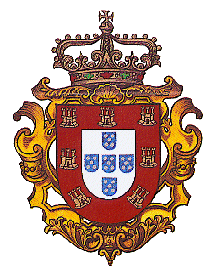
Shield of Arms of D. João IV

D. João IV (1603-1656) was king of "Portugal and the Algarves" from 1640 to his death. He was born at Vila Viçosa, in the province of Alentejo, and married D. Luísa de Gusmão (1613-1666), eldest daughter of the Duke of Medina-Sidonia, in 1633.

By the unanimous voice of the people he was raised to the throne, of which he was held to be the legitimate heir, during the revolution that restored the independence of the kingdom on December 1.st 1640.

In 1642 a treaty was signed between Portugal and England just before the outbreak of the English Civil War, and in 1661 an alliance between both kingdoms was renewed.

In 1646, D. João IV consecrated the nation to Our Lady of Immaculate Conception, who became henceforth the Patroness of Portugal. This is the reason why today is a religious holiday.

D. João IV was a patron of music and the arts, and a considerably sophisticated writer on music; in addition to this, he was a composer himself. During his reign he collected one of the largest music libraries in the world, which was destroyed in the earthquake of 1755. Among his writings are a Defence of Palestrina, and a Defence of Modern Music.


D. Catarina de Bragança, Rainha de Inglaterra

Catarina Henriqueta de Bragança (1638-1705), his daughter, became the queen consort of Charles II of England. They married on May 3.rd or 21.st 1662, in Portsmouth. Her dowry brought Tangier and Bombay to British control.

She was not a particularly popular choice of queen, being a Roman Catholic, which prevented her ever being crowned, since Roman Catholics were forbidden to take part in Anglican services.

Catarina never gave birth to a live heir, though she had several pregnancies, the last being in 1669. Her position was a difficult one, as Charles continued to have children by his many mistresses, but he insisted that she be treated with respect, and refused to divorce her.

Catarina introduced the custom of drinking tea in England.

Although some have claimed that Queens borough of New York City was named after Catarina de Bragança, her name is not mentioned in the first 200 years of historical documents that have been preserved in the county archives.

Following Charles' death, Catarina remained in England through the reign of James II and returned to Portugal in January 1693, during the joint reign of William III and Mary II. She died in Lisbon in 1705.

RIC (mainly adapted from "History of Portugal", Wikipedia, e.a.)

quinta-feira, 7 de dezembro de 2006

Quand la passion pour le Français devient Amour...

Un beau couplet
Qui n'est possible
Qu'en Français!


Витязь (Champion)

"Gall, amant de la Reine, alla, tour magnanime,
Galamment, de l'Arène à la Tour Magne, à Nîmes."

De acordo com uma feliz sugestão de um bloguista amigo, aqui fica a explicação de que este dístico francês não pode ser traduzido sem que se perca por completo o jogo fonético em que se baseia: os sons do primeiro verso são exactamente iguais aos do segundo; apenas as cesuras fazem a diferença semântica. Quanto ao sentido, eis uma possível tradução:

"Gal, amante da Rainha, foi, gesto magnânimo,
Galantemente, da Arena à Torre Magna, em Nîmes."


According to a good suggestion of a blogger friend, here is the English explanation: this French couplet cannot be translated into any other language without completely losing the sound effect that both lines play with: the sounds in the first line are exactly the same as those in the second, in precisely the same order; only the caesuras account for the semantic difference! Isn't that amazing?!
As to the English translation, perhaps some blogger friend might be willing to do it… Joël, would you !? (Haha, caught ya!)

RIC

[Lamento, mas não pude salvar o édito original e os respectivos comentários, que gostaria muito de reaver. Obrigado.
I'm sorry, but I wasn't able to save the original post and its comments, which I would like very nuch to recover. Thank you.]

quarta-feira, 6 de dezembro de 2006

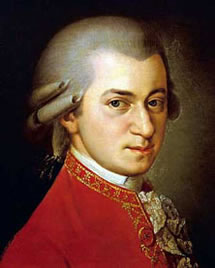
II. Wolfgang Amadeus Mozart in Memoriam


Dear Wolfgang,

I'm really sorry I forgot all about you yesterday. Life nowadays is not like it used to be in your time. Or at least we think it isn't. We're always in such a hurry…

In a TV interview a few days ago, an artist said he didn't like your music so much, because it is limited, basic. Is your music really limited, dear Wolfgang, or is he really an artist? I wonder.

Whatever I might write now would never add anything really meaningful to what so many have already said or written so much better. I prefer to listen to the music you had in your mind the moment you left this world two hundred fifteen years ago.

Confutatis maledictis,
flammis acribus addictis,
voca me cum benedictis.
Oro supplex et acclinis,
cor contritum quasi cinis,
gere curam mei finis.

[When the damned are cast away,
and consigned to the searing flames,
call me to be with the blessed.
Bowed down in supplication I beg you,
my heart as though ground to ashes,
help me in my final hour.]

Requiem Mass, KV 626

R. I. P.

I. Da Língua Portuguesa (3)

"Ein jeder, weil er spricht, glaubt, auch über die Sprache sprechen zu können."

Qualquer um, porque fala, julga que também sabe falar sobre a língua.

Johann Wolfgang von Goethe

– «Cuidado com a Língua»!
– Oh sim, imenso!…

Será possível que tenha de ser um programazinho de televisão a ensinar aos portugueses a Gramática que eles deveriam aprender/ter aprendido na escola?!
Fará isto algum sentido? O regresso de uma serôdia Telescola?

Trouxe‑a versus "trouxe‑la"?!

Pelos olímpicos deuses que alto moram! Anda com certeza muita gente a beber demais…

Trouxe a gramática? → Trouxe‑a.
Trouxeste → Trouxeste‑a.
Trouxe → Trouxe‑a.
Trouxemos → Trouxemo‑la.
Trouxestes → Trouxeste‑la.
Trouxeram → Trouxeram‑na.

Quem fala em público, sobretudo através dos media, não sentirá a responsabilidade e não terá a consciência de que deve estudar Português, em vez de passar o tempo a dizer piadinhas enfadonhas e – parafraseando Eça – a ganir risinhos idiotas?

Que tal este Natal pedir ao Pai Natal um dicionariozinho de verbos conjugados, hein? Não seria má ideia, pois não? Eles estão nas livrarias para isso mesmo: para serem comprados e depois consultados com alguma frequência; não para pôr na prateleira a exibir a lombada, a enfeitar a estante… Não é?

Mas quem é que se vai preocupar com a conjugação pronominal?!
Só maníacos, é claro!
Como eu…

RIC

terça-feira, 5 de dezembro de 2006

Desabafo do dia!!!

Quanto mais me bombardeiam, a toda a hora e a todo o instante, com marcas de trapos, chanatos e tretas (a que pomposamente chamam gadgets), mais a mim me apetece gritar a plenos pulmões e aos quatro ventos que me visto da cabeça aos pés, por dentro e por fora, na feira de Carcavelos! Ou na de Palhavã! Ou na do Relógio! Ou no raio que me parta!
Irra que é demais! Não há c… que aguente tanto consumismo cretino! Nem à lei da bala!

The more they bomb me, every hour and every minute, with marks of rags, shoes, and thingies (they pompously call "gadgets"), all the more I feel like shouting out loud to the full capacity of my lungs and to the four winds that I dress myself from head to toes, inside and outside, at the Carcavelos' market! Or at the Palhavã's! Or at the Relógio's! Or wherever the lightning strikes me dead!
Damn! It's far too much! No a... takes as much cretin consumerism! Not even with a pointed gun!

(NB - The English translation may not be the best one. The reason why is that I'm mad furious! Each day, my love for this season just grows and grows…)

RIC

segunda-feira, 4 de dezembro de 2006

Rainer Maria Rilke (3)


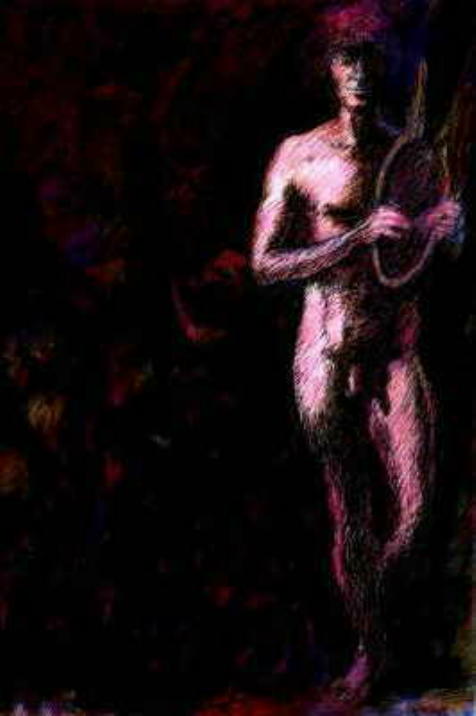
«Orpheus», a pen drawing by Hans Sfiligoi, Vienna

Die Sonette an Orpheus

XIX

Wandelt sich rasch auch die Welt
wie Wolkengestalten,
alles Vollendete fällt
heim zum Uralten.

Über dem Wandel und Gang,
weiter und freier,
währt noch dein Vor-Gesang,
Gott mit der Leier.

Nicht sind die Leiden erkannt,
nicht ist die Liebe gelernt,
und was im Tod uns entfernt,

ist nicht entschleiert.
Einzig das Lied überm Land
heiligt und feiert.

The Sonnets to Orpheus

XIX

Though the world keeps changing its form
as fast as a cloud, still
what is accomplished falls home
to the Primeval.

Over the change and the passing,
larger and freer,
soars your eternal song,
god with the lyre.

Never has grief been possessed,
never has love been learned,
and what removes us in death

is not revealed.
Only the song through the land
hallows and heals.

(Translated by Stephen Mitchell)

domingo, 3 de dezembro de 2006

«Moon River»…


Audrey Hepburn
«Breakfast at Tiffany's»

Moon River, wider than a mile,
I'm crossing you in style some day.
Oh, dream maker, you heart breaker,
Wherever you're going I'm going your way.

Two drifters off to see the world.
There's such a lot of world to see.
We're after the same rainbow's end –
Waiting 'round the bend,
My huckleberry friend,
Moon River and me.

(Henry Mancini & Johnny Mercer)

Adaptación de Pedro Almodóvar
«La Mala Educación»

Moon River… No te olvidaré
Yo no me dejaré llevar
Por el agua, agua turbia
Del río de la luna
Que suena al pasar.

Río y luna / Moon River
Dime dónde están
Mi Dios, el bien y el mal,
Decid.

Yo quiero saber
Qué se esconde en la oscuridad
Y tú lo encontrarás,
Río y luna / Moon River,
Adiós.

Mi luna, ven y alúmbrame,
No sé ni dónde estoy, por qué.
Oigo el rumor de aguas turbias
Que me lleva lejos,
Muy lejos de mí.

Enjoy your Sunday! Rrreeelllaaaxxx!!!…
RIC

sábado, 2 de dezembro de 2006

II. Referendo 2007

Ficámos a saber há dias que o Presidente da República marcou já o referendo nacional sobre a Despenalização da Interrupção Voluntária da Gravidez até às dez semanas para o próximo dia 11 de Fevereiro de 2007, data com a qual todos os partidos políticos representados na Assembleia da República manifestaram já o seu acordo e anuência.

A few days ago the President of the Republic announced the national referendum on the Non-penalization of the Voluntary Interruption of the Pregnancy until ten weeks for next February 11.th 2007. All of the political parties represented in the Assembly of the Republic revealed their agreement and consent to this date.

Dou, aqui e hoje, a minha opinião sobre o assunto, ao qual não voltarei.
Não é minha intenção encetar qualquer polémica.
Prezo a vida acima de tudo.
Abomino tudo o que significa o seu fim.
Da horrenda e bárbara pena de morte, contra a qual, aliás, a Santa Sé raramente se insurge, ao terrível aborto clandestino, que ainda hoje entre nós estropia e mata mulheres.
Muitas ou poucas, é‑me absolutamente indiferente.
Mata.


Não contra‑argumentem, por favor, com a vida do embrião. As escolhas, neste mundo imperfeito feito por homens e mulheres, impõem‑se por si: entre um ser vivo «em acto» que está neste mundo e uma entidade biológica que é um ser «em potência» indesejado ou não, a minha escolha está feita. Quanto ao facto de «poder ser» razão para abuso como meio contraceptivo, gostaria apenas de dizer aos homens – e a algumas mulheres – que assim pensam que deveriam ter as mulheres e o seu psiquismo em melhor conta.

RIC

I. «Câmara Clara»


"Nos anos 80, Prince, o intérprete e compositor norte-americano, cantou a sida como «uma grande doença com um pequeno nome». Se houve sector afectado pela infecção do século foi o meio artístico e intelectual. Desde há 25 anos, a frequência das mortes entre criadores e pensadores implicou uma perda inestimável para o património cultural da humanidade. Por outro lado, grandes livros, filmes, obras visuais, peças de teatro nasceram a partir do tema da doença.

Que impacto teve e tem hoje a sida no comportamento destas comunidades? Que resultados efectivos têm as campanhas de informação e de combate ao contágio? O artista gráfico Henrique Cayatte, que desenhou o símbolo da ABRAÇO e que desde a primeira hora oferece o seu trabalho para o esforço de combate à doença, e Nuno Silva Miguel, um médico psiquiatra com vasta experiência clínica em toxicodependência e saúde mental, e trabalho em educação sexual e prevenção da sida, foram os convidados de Paula Moura Pinheiro. Acaba, entretanto, de sair o último relatório da ONU sobre a situação mundial da sida, cujas conclusões são assustadoras, e assinalou‑se o Dia Mundial Contra a Sida.

Nesta emissão de Dezembro, Câmara Clara apresentou o primeiro de uma série de «cabazes culturais» para o Natal."


Parabéns e obrigado à 2: e a Paula Moura Pinheiro por tão elevado momento.

sexta-feira, 1 de dezembro de 2006

II. December 1.st in Portuguese History

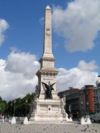
Restaurateurs' Monument and Square, Lisbon

The Restoration of Independence is a holiday commemorated on December 1.st to celebrate the recovery of national independence in 1640 from Spain under the rule of Felipe IV of Habsburg.

The Kingdom of Portugal had lost its independence in 1580, after the young Portuguese king Sebastião disappeared on the battle field of Alcazarquivir (in today's Morocco) in 1578, which put an abrupt end to the House of Aviz, Portugal's Royal Family since 1385.

Felipe II was crowned Felipe I of Portugal in 1580, and the Portuguese House of Habsburg – also called the Philippine Dynasty – began.

During 60 years, as Spain's enemies became Portugal's, a war with England led to a deterioration of the relations with Portugal's oldest ally (since the Treaty of Windsor in 1386) and the loss of Hormuz in the Persian Gulf; a war with the Dutch led to invasions of many places in Asia, and to the definite loss of commercial interests in Japan, Africa (S. Jorge da Mina, in today's Ghana), and South America.

As Felipe IV was trying to make Portugal a Spanish province, and Portuguese nobles were losing power and influence, this deteriorating situation culminated in a revolution by the Portuguese nobility and high bourgeoisie on December 1.st 1640.

It was planned by Antão Vaz de Almada, Miguel de Almeida and João Pinto Ribeiro – the so-called "Conjurados"; together with several associates, they defenestrated the Secretary of State Miguel de Vasconcelos, the traitor, and imprisoned the cousin of Felipe IV, the Duchess of Mantua, who had governed Portugal in his name. The moment was well chosen, as Spain was at the time fighting the Thirty Years' War and also facing popular riots in Catalonia.

D. João, 8.th Duke of Bragança, was acclaimed King of Portugal throughout the country as João IV. Portugal was independent again.

RIC (adapted and abridged from "History of Portugal", Wikipedia)

I. World Day Against AIDS


There's still so much to be done.
Everywhere, either rich or poor...